Saturday, March 25, 2006


Saturday, March 18, 2006
Saturday, March 11, 2006
Tuesday, March 07, 2006
Monday, March 06, 2006
Had another chance to photograph the ISS this evening, got a longer exposure this time (thus a longer track). I must try to get back to some proper astronomy now!

Of course this shot might have been better if the moon wasn't in the way, or would it?
The ISS is passing from right to left.
Immediately to the right of the moon is Mars. Farther to the right of the moon you can see the Pleiades and just below and to the right of the moon is Taurus.
The ISS disappears (in this photo) between Castor and Pollux in Gemini.
The hexagonal shape of the moon is caused by the iris leaves on the lens because I'd stopped it down to f11 to try to avoid over exposure of the sky in general.
Canon EOS 350D ISO:800 33 seconds at f/11.0
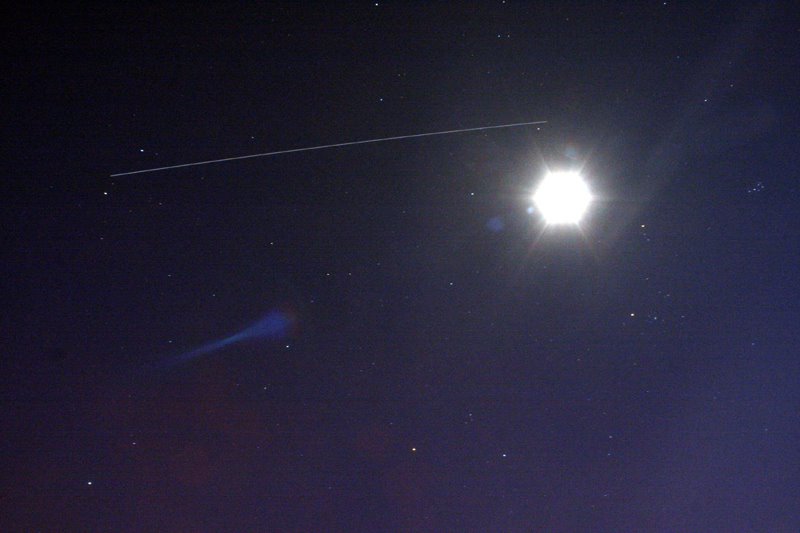
Of course this shot might have been better if the moon wasn't in the way, or would it?
The ISS is passing from right to left.
Immediately to the right of the moon is Mars. Farther to the right of the moon you can see the Pleiades and just below and to the right of the moon is Taurus.
The ISS disappears (in this photo) between Castor and Pollux in Gemini.
The hexagonal shape of the moon is caused by the iris leaves on the lens because I'd stopped it down to f11 to try to avoid over exposure of the sky in general.
Canon EOS 350D ISO:800 33 seconds at f/11.0
Sunday, March 05, 2006
Another successful track of the ISS at 18:26 tonight, watched the whole of its' track across the sky as it skimmed by the moon, probably the brightest I've seen it so far at a magnitude of -0.6.
Tried to view another Iridium flare without success though, must read up some more on these to ensure I'm looking in the right direction.
Clouds are rolling in again now but will try to get outside later if i can.
Tried to view another Iridium flare without success though, must read up some more on these to ensure I'm looking in the right direction.
Clouds are rolling in again now but will try to get outside later if i can.
Friday, March 03, 2006
Clear blue skies all day today after what was apparently the coldest March night in the UK since the 1960's.
I had planned to attempt my first sighting of an Iridium flare, all set for 19:03, but the clouds had rolled in, so back inside. I had also made a note of the ISS pass, and by sheer luck I thought to nip out to see if it was still cloudy without a thought for the time. Bingo, there she was high overhead and dispappeared after passing through Gemini!
More later, hopefully!
Thursday, March 02, 2006
Another clear sky!
I had an ISS track forecast for 18:47 tonight from the WSW. So, set up the camera early but noticed the thin crescent moon that I'd missed last night was on show with a nice amount of earth shine lighting the shadow. So took a few heavily bracketted shots of this first.
Then back to the ISS, sure enough it showed right on time, the following images are variations of my second attempt to capture it on "film". This shot was made with a Canon EOS350D using a 35mm SLR equivalent focal length of 28mm, exposure was 24 seconds at f8.0, speed 800 ISO.

Only had chance for one shot, problem is that the stars etc are so faint through the viewfinder, so didn't start the exposure as soon as I could and I wasn't sure if the ISS was out of view. Next time I will try to get more shots in. The photo above is "as is" from the camera.

This version is after adjust levels in photoshop, interesting that you can now see the atmosphere in daylight. The ISS is the long streak crossing Orion. Below is the forecast plot for this pass from heavens-above, I'd say the prediction couldn't have been better!
 The predicted track of the ISS is shown by the solid line running right to left with a red arrow near its' beginning. Below is an inverted version of the final image as a comparison to the chart.


This is a cropped version of the same shot, must try to get some observing done while I have the chance.
I had an ISS track forecast for 18:47 tonight from the WSW. So, set up the camera early but noticed the thin crescent moon that I'd missed last night was on show with a nice amount of earth shine lighting the shadow. So took a few heavily bracketted shots of this first.
Then back to the ISS, sure enough it showed right on time, the following images are variations of my second attempt to capture it on "film". This shot was made with a Canon EOS350D using a 35mm SLR equivalent focal length of 28mm, exposure was 24 seconds at f8.0, speed 800 ISO.
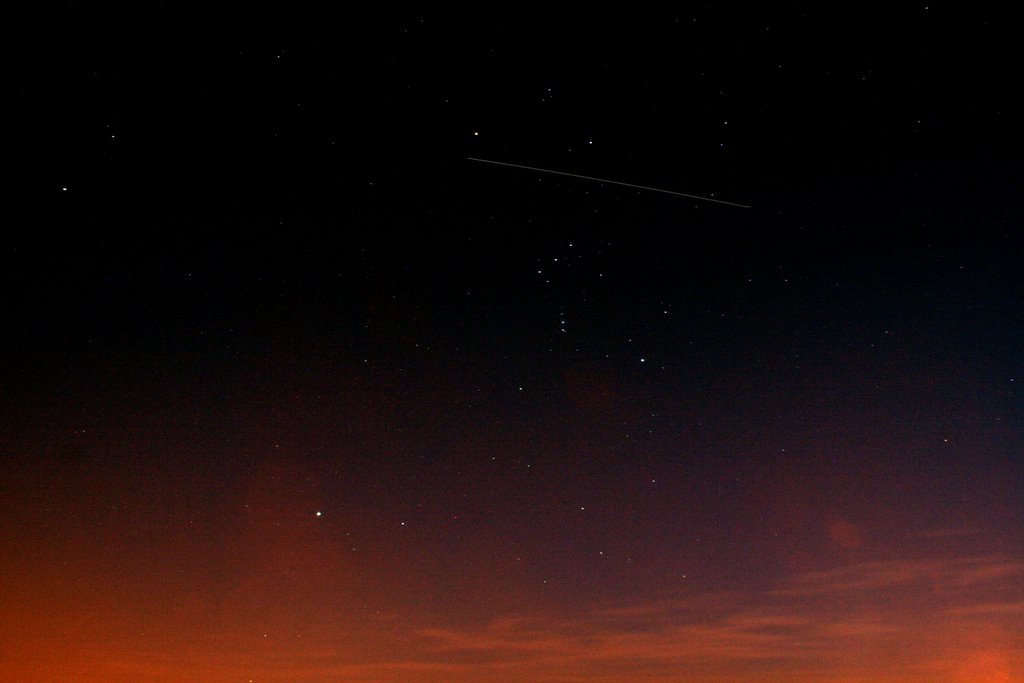
Only had chance for one shot, problem is that the stars etc are so faint through the viewfinder, so didn't start the exposure as soon as I could and I wasn't sure if the ISS was out of view. Next time I will try to get more shots in. The photo above is "as is" from the camera.
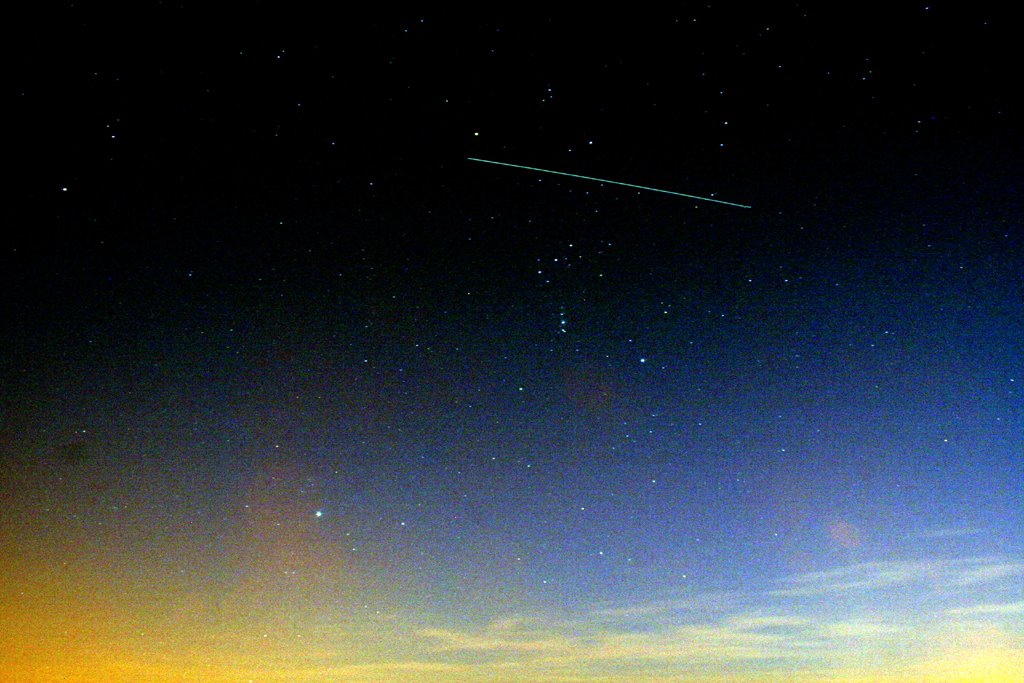
This version is after adjust levels in photoshop, interesting that you can now see the atmosphere in daylight. The ISS is the long streak crossing Orion. Below is the forecast plot for this pass from heavens-above, I'd say the prediction couldn't have been better!
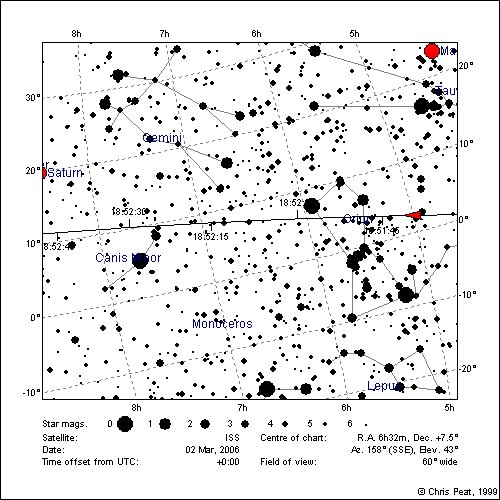 The predicted track of the ISS is shown by the solid line running right to left with a red arrow near its' beginning. Below is an inverted version of the final image as a comparison to the chart.
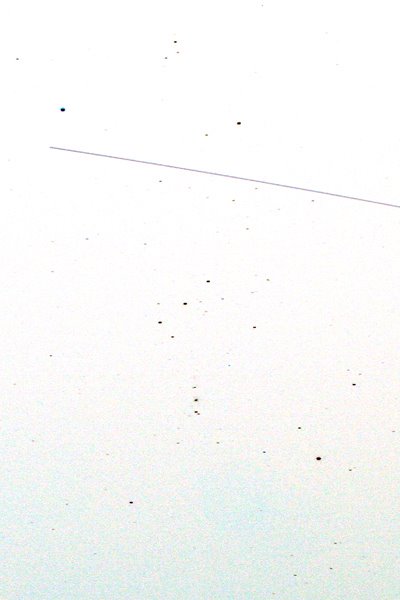

This is a cropped version of the same shot, must try to get some observing done while I have the chance.
Wednesday, March 01, 2006
Another clear evening, although after a long day at work I wasn't feeling up to much tonight.
However, I'd used Heavens Above to predict an ISS siting from my front door at 18:32 GMT. So set up the camera with a wide angle lens and a bulb shutter setting.
Sure enough, the ISS showed on time and was visible for much longer than yesterday, way past Orion and into the distance before it disappeared. Quite spooky really.
So, rushed back in and loaded the image to the PC, I could just make out the track, problem is I think that it was too light, Orion was barely visible at this time. Therefore contrast etc. meant the track wouldn't show. The problem with getting long exposures correct is a trade off of time versus light, to avoid overexposure you compensate normally by stopping down the aperture, doing that in this case means the track is very faint. Never mind, I will try again, especially as I have got the hang of watching for it coming.
BTW in order to use the Heavens Above predictor correctly you need to enter your location, which is quite easy as a list of towns is in the database.
Also had a quick look at Orion, Saturn and started to see some of the clusters low in the southern sky but these will take a lot of work I think.
Found out tonight that Arcturus in Bootes is the 4th brightest star in the Northern sky, it certainly was bright last night.
Tuesday, February 28, 2006
18:50 - At last, a clear sky!
19:15 - Already spotted the Southern Albireo, and....
19:32 - Just had my first attempt at looking for the ISS based on the predictions from Heavens Above. Right on the money, came out of the southwest and went into the earth's shadow just after it went by Orion, brill. Next time I will get my camera ready and try to get a long exposure to capture its track.
20:00 - Saturn is on view (also saw a satellite skim by as I was looking through the scope)and Orion looks brill, Sirius is quite high in the sky already.
22:20 - Arcturus is beaming brightly through the pollution to my East, wondered what it was so checked all my resources. Very bright indeed, getting a bit cold out there now.
Monday, February 27, 2006
Well I've had zero observing opportunities in the past week. Instead of observations I shall try to keep the blog going this week by adding some material about the hardware I use, in order to show potential uptakers of this hobby that you don't need to spend a fortune to enjoy some of the wonders of the nightsky!
Monday, February 20, 2006
Well, only had a couple of very brief observing sessions since last Wednesday. It's been looking promising all afternoon today, but just as twilight is upon us there's a strong bank of clouds approaching from the South!
Anyway, just finished reading the Neil Armstrong biography "First Man", what a book! There's a fair bit of tedious detail at times but the chapters regarding the Apollo program are excellent. The descent to the Lunar surface was riveting stuff, I never appreciated before just how "seat of the pants" it was for them, they really were going into the unknown!
After Neil quit NASA I thought the book again lost its way a tad, a bit like Neil's life maybe? Just how do you top what he accomplished, he knew that he'd never get to fly in space again I guess.
What a life he led though, he earned his pilot's licence 2 weeks after his 16th birthday! His lessons were funded by his part time jobs, which also went some way towards his college fees. Self made man doesn't even begin to describe him in my opinion. I guess it's obvious that he was and always will be my hero, I don't imagine that Neil will ever see this blog, but if he did....I'd be speechless!
A photo in the book shows a 20 year Neil aboard a US Navy carrier off North Korea where he flew 70 plus combat missions!
Anyway, here's a photo I found on the Apollo Archive site, I think it kind of sums up what the book called "amiable strangers" when describing the Apollo 11 crew!

It seems that Buzz wasn't keen on Neil being chosen to be the first man to step on the moon.
Better get outside now and see what I can see! Errm, not very much as it turns out, Capella high overhead now, Mars is near the Pleiades (never can spell that right). That's about all at the minute.
Anyway, just finished reading the Neil Armstrong biography "First Man", what a book! There's a fair bit of tedious detail at times but the chapters regarding the Apollo program are excellent. The descent to the Lunar surface was riveting stuff, I never appreciated before just how "seat of the pants" it was for them, they really were going into the unknown!
After Neil quit NASA I thought the book again lost its way a tad, a bit like Neil's life maybe? Just how do you top what he accomplished, he knew that he'd never get to fly in space again I guess.
What a life he led though, he earned his pilot's licence 2 weeks after his 16th birthday! His lessons were funded by his part time jobs, which also went some way towards his college fees. Self made man doesn't even begin to describe him in my opinion. I guess it's obvious that he was and always will be my hero, I don't imagine that Neil will ever see this blog, but if he did....I'd be speechless!
A photo in the book shows a 20 year Neil aboard a US Navy carrier off North Korea where he flew 70 plus combat missions!
Anyway, here's a photo I found on the Apollo Archive site, I think it kind of sums up what the book called "amiable strangers" when describing the Apollo 11 crew!

For the younger generations who may be wondering who is who, left to right Neil Armstrong, Michael Collins and Edwin "Buzz" Aldrin.
It seems that Buzz wasn't keen on Neil being chosen to be the first man to step on the moon.
Better get outside now and see what I can see! Errm, not very much as it turns out, Capella high overhead now, Mars is near the Pleiades (never can spell that right). That's about all at the minute.
Wednesday, February 15, 2006
06.45 GMT clear sky for first time in a week, Venus shining very bright but by the time I got outside with the scope, clouded over!
20.45 GMT clear again to the south, got the scope out and took a quick look at Saturn, still near the Beehive cluster also known as Praesaepe or M44 in Messiers catalogue. M44 is a 4th magnitude open cluster 550 light years away from us and is 30 light years wide.
Orion Neb quite clear and lower in the sky is Sirius, but Sirius is much higher now (at this hour) than previous obs.
Decided to switch location to the south of the house to see if I can see any of the open clusters in this region of the sky after spotting one of them (without id).
Five minutes later and the cloud had moved in but not before I spotted a new (to me) coloured double. A check with my maps suggests the main star is Puppis 7, which is 1350 light years away!
Looks like that's it for tonight.
Saturday, February 11, 2006
Planetarium Software
Some 10 years ago I purchased a copy of Redshift 2, this was a stunning piece of software at the time, although I felt it was not exactly intuitive to use.2 PCs later and I thought I'd see what was on the web in the way of downloads, well the first I discovered was Cartes du Ciel. This is a very thorough piece of software and will let you print charts based on your date/time/location so that you can take up to the minute charts outside with you. A link for this is in the links section.
Last night I noticed a post on the SPA forum which mentioned a package called Stellarium, so off I popped and got a free copy. As far as looks and ease of use this package will blow you away. It looks simply stunning, I hear that Starry Night is better, but this is freeware! But, you cannot print charts!
So, I'd recommend Cartes du Ciel if you want to print charts but if you want what amounts to a simulator of the night sky then Stellarium is the best. Why not use both, I will!
Friday, February 10, 2006
Some recent Astrophotos
This half moon was taken December 2005, this shot was through the Meade ETX80AT.
This "red" moon was taken September 2005, using the EOS350D and it's 80-200mm zoom lens.

This shot of a "spooky" moon with a cloud floating across was taken August 2005 with the EOS350D and it's 80-200mm zoom telephot lens.

This is a photograph of M45 the Pleaides cluster taken in November 2005, using a Canon EOS350D through a Meade ETX80AT, equivalent focal length = 600mm.


Why this blog?
Well, being born in the early 60's means that I witnessed the Apollo landings on the moon, this sparked a lifelong interest in Astronomy. This interest has waxed and waned over the years but never completely disappeared. My parents bought me 2 telescopes and a pair of binoculars as xmas presents between age 10 and 14.Along the way I have visited the Jodrell Bank Observatory (twice) and experienced the wonders of the planetarium show first hand.
I have only experienced a truly dark sky on one occasion during a holiday with friends in North Wales, amazing is the only word to use.
Spent a fair amount of time observing when comet Hale Boppe appeared on the scene in 1998 (I think). But money was always being spent on other things rather than on new Astro kit.
Anyway, last year (2005) I started to find lots of info on the web and the flame was rekindled, this time I bought some new equipment and started some serious backyard astronomy (by my previous standards).
Managed to fit in lots of observing plus taking some astro photos from October onwards.
Finally decided to put a blog together this week and well, here it is, this will most likely be a mix of observational notes primarily for my own benefit and any tips, hints or websites that I find along the way that I feel might benefit anyone who may drop by.
Wednesday 8th Feb 2006 saw my part of the UK experiencing clear skies for the first time in weeks!
6.30am, awoke to a clear sky and the tempting sight of Jupiter and Venus both fairly high in the southern sky. By 6.45am had dashed out with the Opticron for a quick 5 minutes observing prior to leaving for work. Venus was stunning as a crescent shape while Jupiter gave a nice view of the Gallilean moons and I could just make out the 2 most prominent cloud belts.
5.45pm, back from work and straight outside with the scope for some more viewing. Orion is fairly high in the southern sky now even at this early hour. Capella is almost overhead whilst Sirius effortlessly shines through the band of light pollution that plagues my southern horizon.
Nice view of Saturn in the same field of view as the Beehive cluster, the rings are easily visible with the Opticron, more details of that to follow.
Watched a very bright satellite cross the sky from South to North but to the East of my location. Last time I saw one like this it was confirmed as the International Space Station but that time it moved from West to East. I need to investigate this further to find out if the track varies as much as that. The "Heavens Above" site contains info on the ISS and other satellite tracking data.
My favourite object for the scope is Albireo, the tail (in fact I think it's the head) star of Cygnus, a wonderful sight (a multi coloured double) in even a small scope. However, Cygnus has almost moved on now and Deneb (the topmost star) is low to the North.
Subscribe to:
Posts (Atom)

