Showing posts with label Lyra. Show all posts

Thursday, December 21, 2006

Well, we've been pretty much fogged out here the last few days, so much that Heathrow airport have cancelled half their flights. The last chance I had to use the scope was last Saturday evening, objective was to test out the recalibrated Polar scope.

Got the scope aligned fairly quickly and then started with some piggy backed shots, this time I wanted some shots of Cygnus....


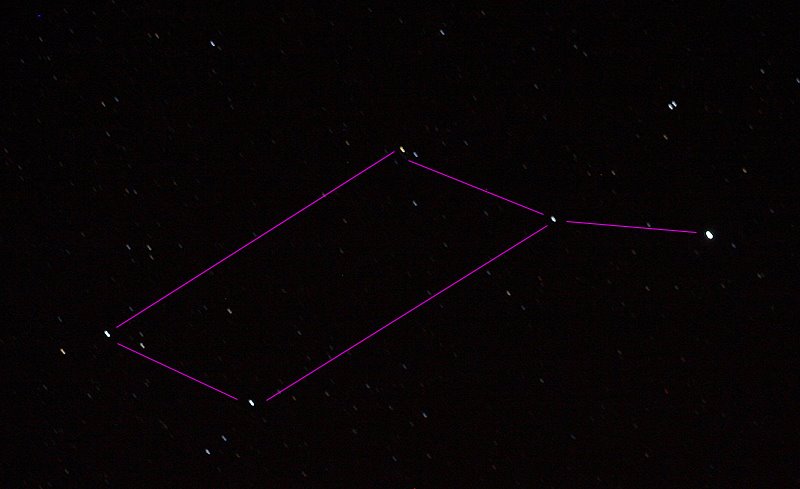
Quite pleased with this 10 minute exposure (longest yet), this shows the rear section of Cygnus with Deneb showing nicely, this is a very rich section of the sky as the Milky Way runs through here. The image below has some lines drawn to show the outline of the constellation, Deneb is top right and is in fact the tail star of the swan.


Next I thought I'd have another go at Lyra as it was higher in the sky than last time and therefore out of the glow of light pollution....


Another 10 minute exposure at ISO:400, 35mm equiv 90mm focal length.

Then I tried some prime focus shots and also using the camera attached to the Barlow lens. The Barlow lens seems to have a blurring effect though.

Also I ran into some camera shake again, I've tried everything to eliminate shake. I purchased a 2 metre extension lead for the remote shutter release, this was then isolated by being clipped to a photo stand next to the scope with plenty of slack between the scope and the stand.

I tried shooting with the mirror lock up function also, all to no avail. I've come to the conclusion that there's either a fault with the drive or my patio (made of concrete slabs) has a bounce in it so that as I walk away the scope is picking up vibrations.

Next opportunity I get I will downsize the camera by removing the battery grip and using the camera in its standard configuration.

Just looked outside and...more fog.

cheers
Mitch

Sunday, December 10, 2006

Last night we had a good few hours of clear skies here after a dodgy start with lots of broken cloud. So I had a go at taking some piggy back images, this is basically taking photos with the cameras own lens rather than through the scope but with the camera attached to the OTA. This way you can get wide field images and long tracked exposures, this one is of Lyra....


Canon EOS350D 35mm Equiv focal length 90mm, 200 seconds at f5.6 ISO:400.

Next is the Pleiades....


Same camera setup but 268 second exposure

The next shot was taken in the direction of Cassiopea but due to the dim view through the camera viewfinder it could be anywhere! Lots of stars, though some of the really tiny stars might be just noise!


Same setup with 411 second exposure

This has to be the downside to this aspect of imaging I think, due to the low magnification and the digital SLR's small frame size (compared to a 35mm SLR, it is 60% of that) you can only make out the very brightest of stars in the finder. Also due to the fact that the lens is autofocus even operating in manual mode is tricky because the lens does not have an infinity setting like the old lenses had. I guess part of the solution is to try and get some older non autofocus EOS lenses.

Finally a wide shot showing a part of Taurus including the Hyades....


Same setup with 259 second exposure.

We've had cloud and rain and lots of wind here all day, watched a recording of the shuttle launch from last night, interestingly it seems that whenever the shuttle is docked with the ISS there are no sightings from my location! Must be an amazing sight to see the whole lot going over.

more later
Mitch

Friday, November 17, 2006

Managed to get outside again for some more clear skies, had another look at Beta Lyra through the MM2 now that I've confirmed what I'm looking at, very nice alternative to Albireo! Lyra is a brilliant little constellation through a small scope or Bin's because all but 2 of its stars are doubles.

Just had my first view of Orion since last Winter, Orion was one of the very few constellations that I could see as a child due to light pollution so is always a welcome sight.

A quick look through the MM2 showed some nebulosity in M42, can't wait to get the Skywatcher on the case, but my back is still playing up!

Also had a peek at another old friend, Aldebaran (the eye of the bull if I remember correctly) and the Hyades open cluster.

Am hoping to stay up to see some of the Leonids meteor shower later as it is still clear at the minute and tomorrow is Saturday so no work!

Later
Mitch

Thursday, November 16, 2006

First clear night for ages! Got outside at 6.30 to see what I could see, I've had a bad back all week so the Skywatcher had to miss out.

First I sat in a deck chair with the Monocular waiting for my eyes to adapt to the dark. Then I tried (again) to see M81 and M82, nothing at all! Out came the MM2 but still nothing, so decided to test the scope on Mizar, the MM2 easily splits the double but not the double double of this famous quartet.

Mizar (the second star in the handle of the big dipper) and its companion are 4 seconds of Arc apart and is a good test for any newcomer with Bin's or small scope.

Next I took a look at Lyra, Vega shining brightly and viewed each of Lyras components, the double double is merely a double with the MM2. Tried to see M57 but not a hope through the spotting scope.

Got a tad confused over Beta Lyra, which through the scope was a double with a blue/white coloured star, lovely to look at. But my book just described it as an "eclipsing variable", not a double so I thought I was looking at the wrong star. According to web sources an eclipsing variable double means the stars are so close that we only know the star is a double by observing changes in luminosity over time. So I'm none the wiser at the minute as to what I was looking at!

A quick look at Albireo was due, as always an excellent sight, looked for M56 half way between Albireo and Beta Lyra, think I found it but not impressive through the MM2 due to its lack of aperture.

Brochi's cluster was nice to see, it just fills the view at the MM2s lowest mag (15x).

Then a quick look to see if I could still find M31, easy once you know where to look! Still just a fuzzy blob though, at least I now know that it stills looks like a fuzzy blob even through a 14" Dobsonian thanks to the astronomy groups last meeting.

The Pleiades look as stunning as ever even through the small aperture.

Later
Mitch

Tuesday, October 10, 2006

Late yesterday afternoon the sky was as clear and blue as it has been for a long time, as the sun went down though some high cirrus clouds started to drift in. Next the waning full moon made an apearance. All in all not ideal conditions for setting up the scope.

So I decided to take the camera out to see what I could get n terms of static photos.

First up was Lyra...


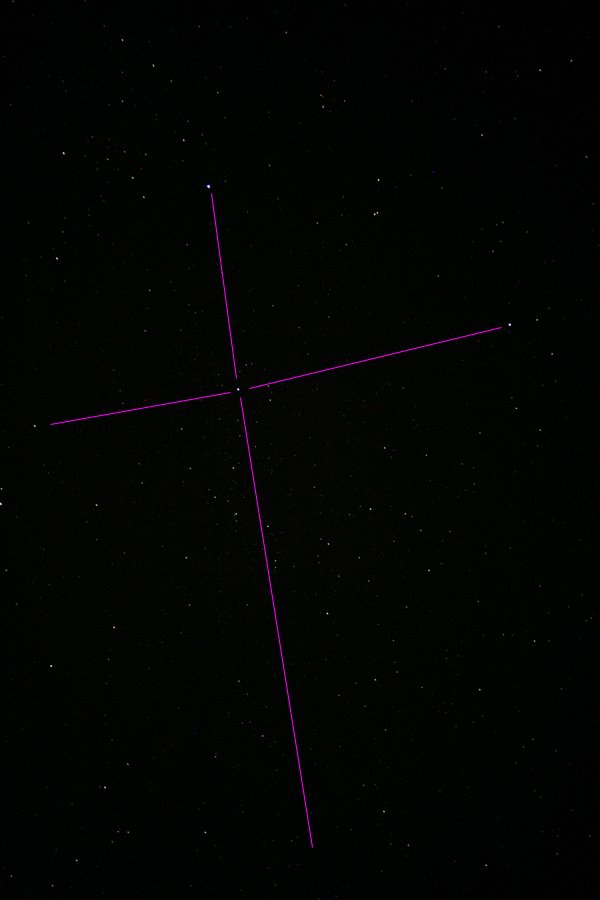
Next was Cygnus....


Then Cassiopeia....


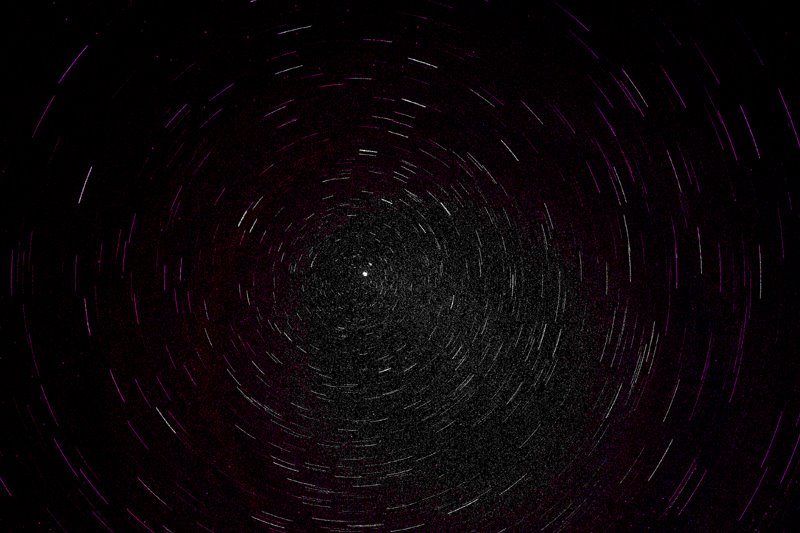
Finally, I've always wanted to try one of those photos where the stars trail around Polaris...


This final picture was a 30 minute exposure, and it took nearly another 30 mins for the camera to process it. After all that there was a lot of noise, the image above was after post processing in Photoshop to reduce noise and adjusting levels.

Sunday, September 03, 2006

Bought the September issue of the Sky at Night magazine this morning, so after reading that Neptune and Uranus are on view this month I decided to see what I could see.

So just as twighlight fell I was outside to take a look.

Got my first view in a while of Jupiter as it sank in the west, due to the low altitude I didn't see much other than the main moons.

The moon was bright to my south, which is where I was looking for the aforementioned planets, thanks to the moon and scattered cloud tonight's mission was not accomplished, my southern horizon is not good at the best of times. But I have a few weeks yet to see them, these will be a first for me, never saw them as a child like I did with Jupiter and Saturn, they are like old friends to me now!

Anyway, did get to see Lyra and Cygnus again along with Cassiopeia and of course Ursa Major. Albireo was a nice sight as always and the monocular gave a nice view of the doubles in Lyra but not of course the double double.

Earlier in the week I decided to upgrade the Meade ETX80 with something a tad more serious. This time I am refusing to be seduced by GOTO features and concentrate on aperture and a serious mount. After some advice I've decided to go for a Skywatcher 200mm Newt on a heavyduty motorised mount. At a price of £539 this looks like a bargain after I paid £300 for the Meade.

I was almost in the car on a 65 mile trip to the shop to buy this yesterday when I decided to check availability, that turned out to be a good call, the mount is out of stock until the end of the week. So hopefully this time next week I'll be the proud owner of a new scope. I will try to sell the Meade on eBay as I don't have the space to keep it as well as the new kit.

Tuesday, August 29, 2006

For the first time in ages I managed to make sure that I acclimatised my eyes properly, and on such a clear night it was well worth the effort.

I dragged out of the garage an obsolete reclining office chair and a footstool and leant back with my feet up for a good hour using the Mark I Eyeball aided occasionally by my Opticron Monocular.

Probably my most rewarding night's observing in a long time. Lyra and Cygnus were very clear and I could just make out the Milky Way running through that part of the sky, no mean feat where I live!

Looking through the monocular in these areas was breathtaking, countless numbers of stars!

I also had my eye on Cassiopiae and Perseus, the double cluster was a nice sight again.

For the first time I was able to spot the Andromeda galaxy with the naked eye!

Then, the Mrs turned on the bathroom light!

I was only today telling someone at work that you don't need to buy lots of kit to enjoy the night sky!

cheers
Mitch

Monday, August 28, 2006

Clear skies tonight :o)

Due to my restricted viewing at my location I've decided that I need to concentrate my observing on getting to know my particular piece of the sky better. Number one on my list has to be Cassiopiae and the multitude of clusters etc around it.

Interestingly it's an immediately identifiable constellation, but, when viewed through an eyepiece of any magnification I can't make head nor tale of it, I must need to use a ultra low powered instrument methinks.

The Monocular has now been tripod mounted due to some eBay purchases of Manfrotto clamps. I got a great view of Brochis cluster (coat hanger) tonight with this low powered intrument. Also some nice sweeping views through Cygnus and Lyra.

Incidentally tonight was probably my first proper view of Lyra as a constellation, last autumn/winter it was lower in the sky and thus obscured by light pollution.

Anyway, whilst getting my eyes skyworthy I noticed what seemed to be the ISS cruising from North to South across my zenith. Yet 5 minutes later, I saw another candidate for the ISS cruising in the opposite direction! The second satellite must have gone behind some high cloud because it dimmed considerably before suddenly brightening again.

The highlight of tonight though....I watched a meteor pass overhead from NW to SE through Cygnus and it was a sight! There was a definite smoke trail and it brightened a few times although I saw no debris falling away. It seemed to last forever but probably only lasted 15 seconds or so.

Anyway, a good start to the new observing season for us lackies who can't be bothered to stay up all night through the summer.

Later,
Mitch