Well, travelling home from work at 5.00pm today things were looking promising, lovely clear sky.
So, got in fed the dog etc and generally rushed around to get changed and get the scope set up. Polar alignment was a breeze, set the scope aimed at Capella and started tracking while I dashed back into change again, I'd bought some thermals just after xmas so wanted to try out the long sleeve vest (just like my grand father used to wear!).
Rushed back outside again and Capella was still in the centre of the FOV!
Then I noticed the clouds....managed to get a lovely view of the Pleiades with the 40mm EP (25x mag). Then the clouds were everywhere :o(
I only had an hour or so tonight free as I have to do some work after supper!
What a let down, will try to get out later if I get the time and if it clears up of course!
later
Mitch
Showing posts with label Pleiades. Show all posts
Showing posts with label Pleiades. Show all posts
Wednesday, January 10, 2007


Thursday, December 28, 2006
Things are looking promising right now, just got the scope setup outside, should be dark enough to get the alignment done in ten minutes or so. Vega is always the first star to appear closely followed by Capella, Polaris isn't bright enough to be seen through the polarscope as yet.
Just checked on Heavens Above and I have 2 passes of the ISS today, first at 17.05 next at 18.40.
Well, the ISS showed right on time, got a very nice view as it crossed the sky, not the brightest of passes but still very impressive.
Next I set to aligning the scope, as I wasn't planning on taking any photos I was happy with a very rough alignment, with the new (xmas present) 40mm EP it takes quite a while to drift.
First target was the Pleiades, the 40mm EP is perfect for this, got the entire cluster in the same FOV, as I was adjusting focus a satellite whizzed by and appeared to increase in brightness as it crossed the FOV.
Next target was Taurus, I'm not sure if it's just me but the Hyades seems almost quite boring as there are practically no background stars in this area of the sky. As I aligned the scope on Aldebarran amazingly another satellite skimmed across the FOV!
As I stood back to look at the whole sky with the naked eye I spotted another ISS like object moving North at a steady pace. Of course it's because it's so close to sunset that I can see these satellites, later on they are not so easy to see (if at all).
Unfortunately that looks like it for now as the moon is merrily lighting up my southern sky and nicely highlighting all the high cloud that is making the seeing conditions not so good. Did get a nice view of Albireo with the 40mm (25x) and 25mm (40x) EP's.
Left the scope set up waiting for Orion, wanted to see M42 through the new EP. Got to 19.50 and Orion was beginning to show his shoulders and...you guessed, clouds started to roll in!
More later
Thursday, November 16, 2006
First clear night for ages! Got outside at 6.30 to see what I could see, I've had a bad back all week so the Skywatcher had to miss out.
First I sat in a deck chair with the Monocular waiting for my eyes to adapt to the dark. Then I tried (again) to see M81 and M82, nothing at all! Out came the MM2 but still nothing, so decided to test the scope on Mizar, the MM2 easily splits the double but not the double double of this famous quartet.
Mizar (the second star in the handle of the big dipper) and its companion are 4 seconds of Arc apart and is a good test for any newcomer with Bin's or small scope.
Next I took a look at Lyra, Vega shining brightly and viewed each of Lyras components, the double double is merely a double with the MM2. Tried to see M57 but not a hope through the spotting scope.
Got a tad confused over Beta Lyra, which through the scope was a double with a blue/white coloured star, lovely to look at. But my book just described it as an "eclipsing variable", not a double so I thought I was looking at the wrong star. According to web sources an eclipsing variable double means the stars are so close that we only know the star is a double by observing changes in luminosity over time. So I'm none the wiser at the minute as to what I was looking at!
A quick look at Albireo was due, as always an excellent sight, looked for M56 half way between Albireo and Beta Lyra, think I found it but not impressive through the MM2 due to its lack of aperture.
Brochi's cluster was nice to see, it just fills the view at the MM2s lowest mag (15x).
Then a quick look to see if I could still find M31, easy once you know where to look! Still just a fuzzy blob though, at least I now know that it stills looks like a fuzzy blob even through a 14" Dobsonian thanks to the astronomy groups last meeting.
The Pleiades look as stunning as ever even through the small aperture.
Later
Mitch
Wednesday, November 01, 2006
The sky was teasing at dusk, clear blue skies all day and just as it was getting dark, clouds appeared from nowhere! I kept an eye open though and just after 7.00pm it looked like it would be worth setting up the scope.
The polar alignment was getting a bit easier but it's still not perfect, time will tell.
Anyway took a couple of tracked pics of the Pleaides but not that impressive yet..

So then I tried to locate the Double Cluster in Perseus, not an easy task with the scope, actually it's probably easier with the Monocular. After a few minutes I had what looked like a likely suspect.

The problem I have at the minute is that the camera adaptor for the scope actually uses part of the 1.25" EP holder. In order to attach the camera you have to unscrew the EP holder from its base plate and screw the base plate to the T Adaptor for your camera model. This means that swapping from an EP to the camera is not very slick.
So I end up scoping for targets through the camera viewfinder which is quite dim and very difficult to focus unless you have a bright star like Vega to focus on.
I need to find out if I can buy an additional base plate, of course I will probably have to buy a complete EP holder, that way I can switch from EP to camera relatively quickly.
Friday, October 13, 2006
What started as a promising evening turned out cloudy again.
Initially, as twilight was falling it looked very promising, then it looked like this mornings fog was returning, then it cleared again.
So deciding that one must make the effort even though after a tough week at work I just felt like doing nothing...I carted out the Skywatcher.
After failing miserably to polar align the scope I decided to scan the sky to see what I could see. But to be honest that sort of observing is rarely productive in my experience.
In the end I noticed that the Pleaides were rising so I decided to set up the camera to try my first photos of the Seven Sisters through the new scope. I got in a couple of shots but by the time I had decided on a shutter speed and orientation of the camera frame, guess what?
The Pliaedes had disappeared behind a huge bank of cloud that had crept up from the south! Mission aborted for now!
Later
Mitch
Friday, September 22, 2006
After a rainy afternoon I was quite pleased to see some clear skies tonight.
Took the Skywatcher outside around 10.00pm but high clouds again spoilt the view. I did manage to get a glimpse of the double cluster, the increase in aperture from 80mm (on the Meade) to 200mm made this an amazing sight through the scope!
Just as I spotted the Pleiades a meteor flashed by them! The seven sisters were quite low in the sky but the Skywatcher easily showed lots of detail though I couldn't the complete cluster using the 25mm EP. I am thinking about buying a lower power EP, say 40mm, for this kind of observing.
When the Pleiades are higher in the sky I will try to get some long exposure photos, I have high hopes for that.
That's all I had time for last night what with the clouds etc.
Later
Mitch
Monday, April 03, 2006
Just looked outside and the sky is clear, so ran outside with the Opticron to get a nice view of the waxing crescent moon, a couple of craters stood out most impressively along the terminator.
The Pleiades are fairly low to my north west and not as impressive as on earlier observations when to the south. Orion is way around to the west and Arcturus is very bright to the East.
Overall seeing conditions are not very impressive though, will try again later.
The Pleiades are fairly low to my north west and not as impressive as on earlier observations when to the south. Orion is way around to the west and Arcturus is very bright to the East.
Overall seeing conditions are not very impressive though, will try again later.
Monday, March 06, 2006
Had another chance to photograph the ISS this evening, got a longer exposure this time (thus a longer track). I must try to get back to some proper astronomy now!

Of course this shot might have been better if the moon wasn't in the way, or would it?
The ISS is passing from right to left.
Immediately to the right of the moon is Mars. Farther to the right of the moon you can see the Pleiades and just below and to the right of the moon is Taurus.
The ISS disappears (in this photo) between Castor and Pollux in Gemini.
The hexagonal shape of the moon is caused by the iris leaves on the lens because I'd stopped it down to f11 to try to avoid over exposure of the sky in general.
Canon EOS 350D ISO:800 33 seconds at f/11.0
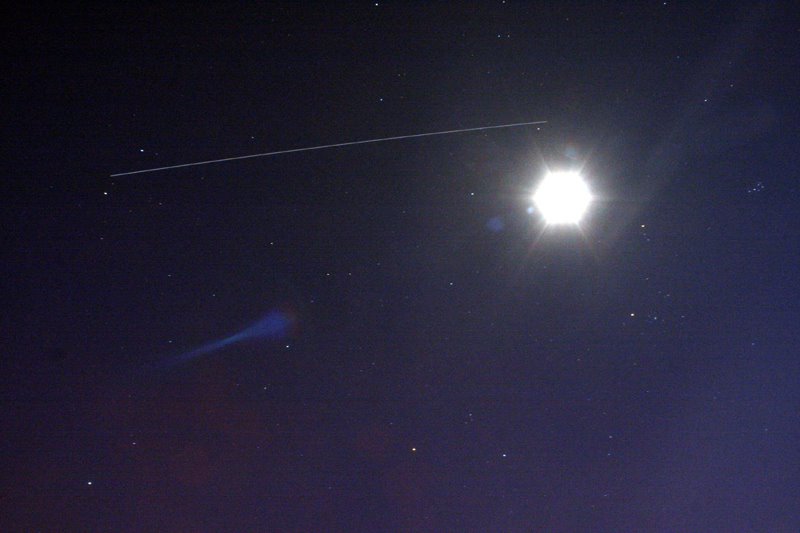
Of course this shot might have been better if the moon wasn't in the way, or would it?
The ISS is passing from right to left.
Immediately to the right of the moon is Mars. Farther to the right of the moon you can see the Pleiades and just below and to the right of the moon is Taurus.
The ISS disappears (in this photo) between Castor and Pollux in Gemini.
The hexagonal shape of the moon is caused by the iris leaves on the lens because I'd stopped it down to f11 to try to avoid over exposure of the sky in general.
Canon EOS 350D ISO:800 33 seconds at f/11.0
Friday, February 10, 2006
Some recent Astrophotos
This half moon was taken December 2005, this shot was through the Meade ETX80AT.
This "red" moon was taken September 2005, using the EOS350D and it's 80-200mm zoom lens.

This shot of a "spooky" moon with a cloud floating across was taken August 2005 with the EOS350D and it's 80-200mm zoom telephot lens.

This is a photograph of M45 the Pleaides cluster taken in November 2005, using a Canon EOS350D through a Meade ETX80AT, equivalent focal length = 600mm.


Subscribe to:
Posts (Atom)

