Things are looking promising right now, just got the scope setup outside, should be dark enough to get the alignment done in ten minutes or so. Vega is always the first star to appear closely followed by Capella, Polaris isn't bright enough to be seen through the polarscope as yet.
Just checked on Heavens Above and I have 2 passes of the ISS today, first at 17.05 next at 18.40.
Well, the ISS showed right on time, got a very nice view as it crossed the sky, not the brightest of passes but still very impressive.
Next I set to aligning the scope, as I wasn't planning on taking any photos I was happy with a very rough alignment, with the new (xmas present) 40mm EP it takes quite a while to drift.
First target was the Pleiades, the 40mm EP is perfect for this, got the entire cluster in the same FOV, as I was adjusting focus a satellite whizzed by and appeared to increase in brightness as it crossed the FOV.
Next target was Taurus, I'm not sure if it's just me but the Hyades seems almost quite boring as there are practically no background stars in this area of the sky. As I aligned the scope on Aldebarran amazingly another satellite skimmed across the FOV!
As I stood back to look at the whole sky with the naked eye I spotted another ISS like object moving North at a steady pace. Of course it's because it's so close to sunset that I can see these satellites, later on they are not so easy to see (if at all).
Unfortunately that looks like it for now as the moon is merrily lighting up my southern sky and nicely highlighting all the high cloud that is making the seeing conditions not so good. Did get a nice view of Albireo with the 40mm (25x) and 25mm (40x) EP's.
Left the scope set up waiting for Orion, wanted to see M42 through the new EP. Got to 19.50 and Orion was beginning to show his shoulders and...you guessed, clouds started to roll in!
More later
Showing posts with label Taurus. Show all posts
Showing posts with label Taurus. Show all posts
Thursday, December 28, 2006


Sunday, December 10, 2006
Last night we had a good few hours of clear skies here after a dodgy start with lots of broken cloud. So I had a go at taking some piggy back images, this is basically taking photos with the cameras own lens rather than through the scope but with the camera attached to the OTA. This way you can get wide field images and long tracked exposures, this one is of Lyra....

Canon EOS350D 35mm Equiv focal length 90mm, 200 seconds at f5.6 ISO:400.
Next is the Pleiades....

Same camera setup but 268 second exposure
The next shot was taken in the direction of Cassiopea but due to the dim view through the camera viewfinder it could be anywhere! Lots of stars, though some of the really tiny stars might be just noise!

Same setup with 411 second exposure
This has to be the downside to this aspect of imaging I think, due to the low magnification and the digital SLR's small frame size (compared to a 35mm SLR, it is 60% of that) you can only make out the very brightest of stars in the finder. Also due to the fact that the lens is autofocus even operating in manual mode is tricky because the lens does not have an infinity setting like the old lenses had. I guess part of the solution is to try and get some older non autofocus EOS lenses.
Finally a wide shot showing a part of Taurus including the Hyades....

Same setup with 259 second exposure.
We've had cloud and rain and lots of wind here all day, watched a recording of the shuttle launch from last night, interestingly it seems that whenever the shuttle is docked with the ISS there are no sightings from my location! Must be an amazing sight to see the whole lot going over.
more later
Mitch
Thursday, November 23, 2006
Went outside tonight at 5.40pm to see if we had clear skies, patchy clouds were around so I decided to have some supper and try again later. Just as I turned my head I saw a very bright object moving to my NNW quite high in the sky almost as soon as I saw it it disappeared and I thought it must have been the ISS. I had checked earlier to see if we had any predicted sightings with a negative answer.
I double checked on Heavens Above, no sightings for tonight were predicted. I then thought it might have been an Iridium flare, again nothing for my time/location.
So no idea what this was, it was very bright, much brighter than anything I've seen before and was a blue/white colour. It didn't look like a meteor and the slow way that it disappeared makes me think it was man made and was entering the earths shadow.
Anyhow, managed to get the scope out for an hour and tried some more photos to prove out the calibration of the mount. So tried for some 3 minute exposures, it seems my problem now though is that I need to get an extension cable for the remote release on the camera. It seems the action of letting go and picking up the controller is giving me camera shake in a big way. This is only a problem when using the "bulb" setting for say a 3 minute exposure. A shorter 30 second shot without letting go of the controller seems ok. But I'm desperately trying to get some long accurately tracked images so that I can pull out more background stars!
Found some extension leads on eBay today so will look at getting one.
Anyway here's a picture of the Hyades open cluster in Taurus....

Tomorrow night is the Rosliston Astronomy group meeting (I think), wonder if we'll get a clear sky again?
Later
Mitch
I double checked on Heavens Above, no sightings for tonight were predicted. I then thought it might have been an Iridium flare, again nothing for my time/location.
So no idea what this was, it was very bright, much brighter than anything I've seen before and was a blue/white colour. It didn't look like a meteor and the slow way that it disappeared makes me think it was man made and was entering the earths shadow.
Anyhow, managed to get the scope out for an hour and tried some more photos to prove out the calibration of the mount. So tried for some 3 minute exposures, it seems my problem now though is that I need to get an extension cable for the remote release on the camera. It seems the action of letting go and picking up the controller is giving me camera shake in a big way. This is only a problem when using the "bulb" setting for say a 3 minute exposure. A shorter 30 second shot without letting go of the controller seems ok. But I'm desperately trying to get some long accurately tracked images so that I can pull out more background stars!
Found some extension leads on eBay today so will look at getting one.
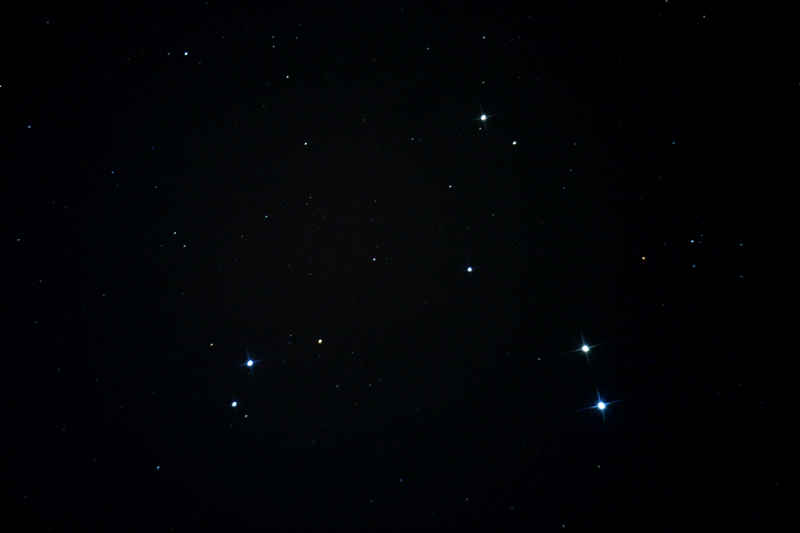
Anyway here's a picture of the Hyades open cluster in Taurus....
Tomorrow night is the Rosliston Astronomy group meeting (I think), wonder if we'll get a clear sky again?
Later
Mitch
Friday, November 17, 2006
Managed to get outside again for some more clear skies, had another look at Beta Lyra through the MM2 now that I've confirmed what I'm looking at, very nice alternative to Albireo! Lyra is a brilliant little constellation through a small scope or Bin's because all but 2 of its stars are doubles.
Just had my first view of Orion since last Winter, Orion was one of the very few constellations that I could see as a child due to light pollution so is always a welcome sight.
A quick look through the MM2 showed some nebulosity in M42, can't wait to get the Skywatcher on the case, but my back is still playing up!
Also had a peek at another old friend, Aldebaran (the eye of the bull if I remember correctly) and the Hyades open cluster.
Am hoping to stay up to see some of the Leonids meteor shower later as it is still clear at the minute and tomorrow is Saturday so no work!
Later
Mitch
Monday, March 06, 2006
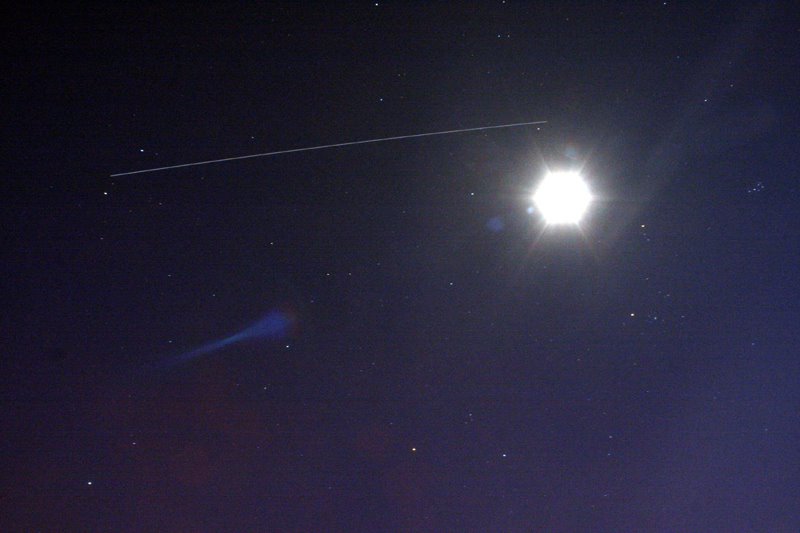
Had another chance to photograph the ISS this evening, got a longer exposure this time (thus a longer track). I must try to get back to some proper astronomy now!

Of course this shot might have been better if the moon wasn't in the way, or would it?
The ISS is passing from right to left.
Immediately to the right of the moon is Mars. Farther to the right of the moon you can see the Pleiades and just below and to the right of the moon is Taurus.
The ISS disappears (in this photo) between Castor and Pollux in Gemini.
The hexagonal shape of the moon is caused by the iris leaves on the lens because I'd stopped it down to f11 to try to avoid over exposure of the sky in general.
Canon EOS 350D ISO:800 33 seconds at f/11.0
Of course this shot might have been better if the moon wasn't in the way, or would it?
The ISS is passing from right to left.
Immediately to the right of the moon is Mars. Farther to the right of the moon you can see the Pleiades and just below and to the right of the moon is Taurus.
The ISS disappears (in this photo) between Castor and Pollux in Gemini.
The hexagonal shape of the moon is caused by the iris leaves on the lens because I'd stopped it down to f11 to try to avoid over exposure of the sky in general.
Canon EOS 350D ISO:800 33 seconds at f/11.0
Subscribe to:
Posts (Atom)

