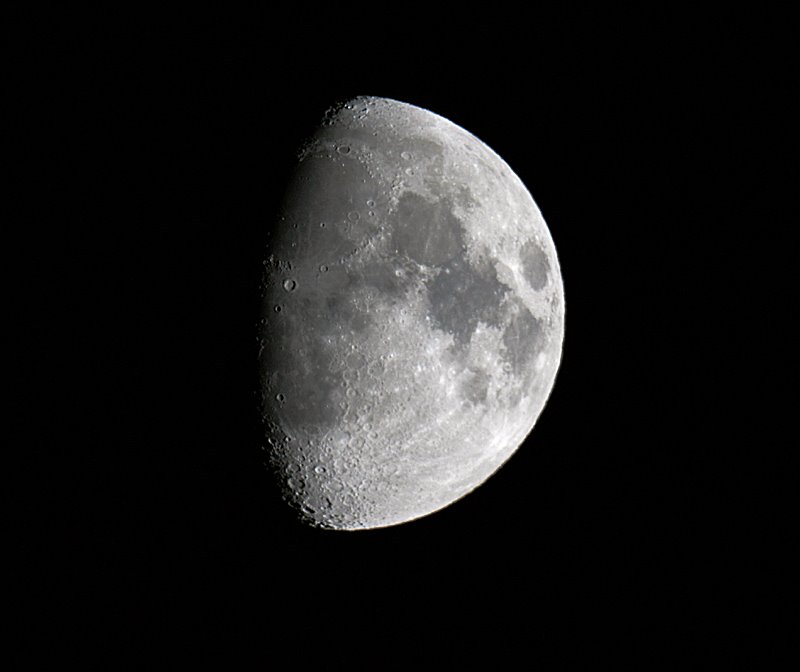
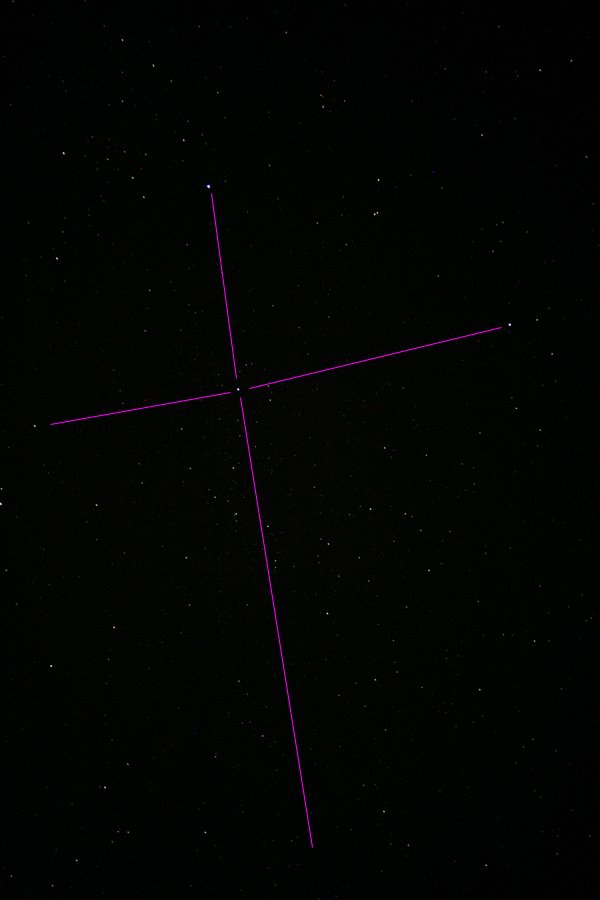
Monday, February 04, 2008

I'm often asked about hardware, which brand, how much to spend etc, well here's my view, remember that I'm not a professional and I'm not even that experienced as an amateur compared to many many others. I have though in the last few years gone through the pain of deciding what to buy and living with the consquences.

Most people when starting out in Astronomy will usually assume that to do any useful observing you need large and very expensive instruments. I have found through personal experience that "hardware" quality and capability can vary quite amazingly.

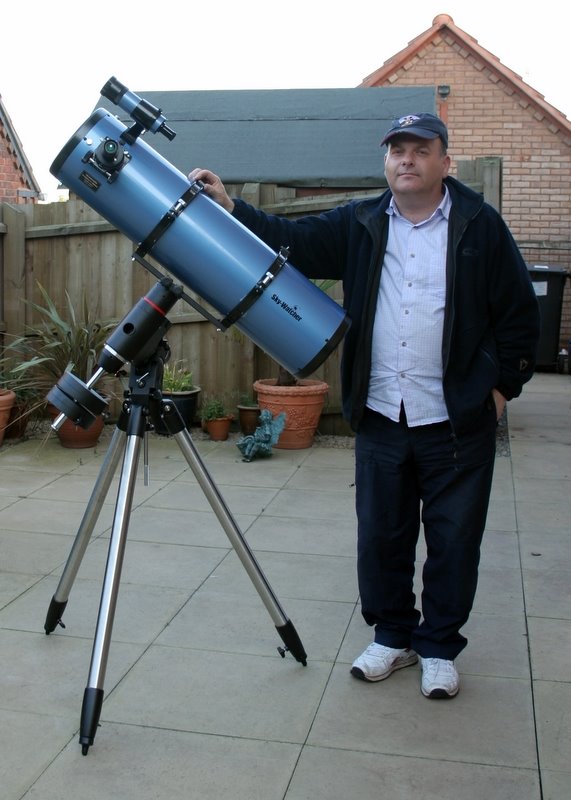
The Skywatcher 200m aperture x 1000mm focal length "Newt" on its heavy duty motorised Equatorial mount might look very costly. The reality was a cost of around £500 in 2006 and depending on your personal circumstances only you can be the judge as to whether that is a lot of money. Of course for that money one can buy a washing machine or a Personal Computer.


If your budget won't stretch that far most peoples advice is to buy some binoculars. However, I could argue that a good quality pair of Binoculars could easily cost more than the telescope above!

I was tempted to buy some Bin's a couple of years ago but was wary as I don't have full use of my right eye, my logic was that I would be paying for two lots of optics when I could only use one. So a visit to my local "camera shop" introduced me to the Opticron brand which I had previously not heard of.

I was able to compare an Opticron spotting scope with another make and quickly decided the Opticron was better optically. So £240 poorer I left with my purchase and eagerly awaited a clear night, now, I was fortunate that in a former life I had worked as a professional wedding photographer and as such I already owned a heavy duty tripod which was instantly pressed into use.


You might be amazed to know that this scope can easily show the 4 Gallilean moons of Jupiter and if conditions are good then some cloud banding is also visble.


The scope has a zoom eyepiece (15-40x mag) and a 52mm objective lens and easily splits the double star of Albireo in Cygnus and the rings of Saturn are easily defined but don't expect to see too much detail.

A lesson learnt though is that I should have considered a larger aperture spotting scope rather than this "travel scope", at max mag the view is quite dim, ironically this is more noticeable in daylight when used for terrestrial viewing.

A later purchase acquired an Opticron 10x42 monocular which I also find needs to be tripod mounted to be of much use and is a fine instrument also.


Of course if you have a bigger budget then the sky really s the limit....


My view on what to buy is that you must consider the following....

  • Firstly - before parting with any of your hard earned cash, don't discount your most valuable asset, the good old Mark 1 Eyeball, if you let yourself get dark adapted properly and sit back in a deck chair on a good clear night you will be amazed at what you can see!
  • Cost - if you've just won the lottery then you won't care what I think because you'll just buy the most expensive kit in the catalogue, if you aren't a millionaire then get the best you can afford while considering the following.
  • Aperture - the wider the tube (OTA - Optical Tube Assembly) the brighter the image
  • Mounting - a camera tripod is fine for small scopes/bin's but at high mag's the sky appears to rotate very quickly meaning that you are constantly adjusting the scope to keep your subject in view. A motorised equatorial mount is great for keeping pace with the rotation of the earth as well as allowing long exposure photography. Remember though that once you've aligned the mount you can't move the scope around your garden without realigning it each time you move it. Also, the assembly above is very heavy, I can only just lift the assembly to move it an inch or two. So setup time has to be accounted for, several trips are needed to cart it all into position and then it needs to be assembled and aligned, although practice makes this quicker.
  • Optical quality - should really be number one but it is this which mostly impacts cost and so to most people the best optics remain out of range of our pockets. Also, I'd say that the importance of optical quality drastically increases with magnification, cheap high power EP's will be useless even on a good OTA and mount. Top of the range bin's can cost many hundreds of pounds but will show stunning detail compared with cheaper alternatives.
  • Magnification - don't expect to see the kind of views as seen in books and magazines that were taken using the Hubble Space Telescope. Also remember that long exposure photography reveals far more detail than the naked eye even on amateur scopes. Last year I purchased a low power 40mm EP for the Skywatcher which effectively turned it into a 25x200mm monocular and the view is amazing!
  • Computer guidance - sounds great, but having thousands of objects in a database is not much use if the optics won't let you see them!

To summarise, cheap optics on a good tripod will be a waste of money as would good optics on a cheap mounting. High magnification EP's reduce image brightness significantly and thus require more aperture in order for you to see anything and the higher the mag the more crucial is the mounting in terms of tracking and vibration free viewing.

Remember that "proper" scopes are like "proper" cameras, the EP's or lenses that come as standard are usually just that, basic. You can always buy better quality later, often a top quality EP or lens for a camera will cost more than you paid for the scope/camera in the first place.

Later
Mitch

Tuesday, January 08, 2008

Well, the first post of 2008 and I still haven't had the time to get the scope out. Over the xmas hols I was hoping to spend some time but whenever I had the time the skies were clouded out.

I have the added problem now that my only hardstanding area is next to the house and not the shed at the end of the garden. I suspect the weight of the scope would make the tripod sink into the soft grass.

Eventually I need to place 3 stepping stones such that when the tripod feet are set on them the mount is roughly polar aligned already.

I've also missed a few predicted ISS passes due to being late leaving work :o(

Here's to a more fruitful year with my sky watching!

later
Mitch

Friday, December 07, 2007

Believe it or not the kitchen will be completed this weekend, it's been a nightmare of a job.

But this means I can start to sort out my workshop and extract the Skywatcher for the first time since I can't remember when.

The December edition of Sky at Night magazine includes on their cover disk two episodes about Jodrell Bank among other things, watched them both last night.

So, as long as the nights stay clear I'm looking forward to getting some observing done, especially over the xmas hols.

later
Mitch

Friday, September 14, 2007

Just got back after picking the Mrs up from a night out, the sky is probably the clearest for a year.

So managed to pop out to see what my new skies are like for the first time since we moved. The most notable improvement is that I now have a clear view to my East and a darker sky to my South than previously.

Saw a meteor flash through Cassiopea before noticing that I can make out the bright band of the Milkyway.

All main stars of Lyra were visible to the naked eye including the double double which is very unusual.

I'm still very busy with the renovation of the kitchen so haven't had the time to sort out my workshop and hence the Skywatcher.

Next weekend we are spending a couple of nights in the Lake District so will hope to get some even darker skies assuming it stays clear.

More later.
Mitch

Wednesday, August 15, 2007

Despite the clouds tonight I managed to watch the ISS pass over just now, it was so bright that I could easily see it through the thin clouds to my West. Jupiter was beaming away to the South but clouds are rolling in, pity that I didn't take my monocular out to see the ISS, might have seen the shuttle.

Another pass is due tomorrow night so will hopefully catch the shuttle then!

later
Mitch

Monday, August 13, 2007

Last night I spent 2 hours from 10.00pm looking for the Perseids meteors, I managed to see 2!

But importantly I saw 2 meteors from the Perseid shower rather than what are known as "sporadic meteors". I know this because the 2 that I saw came from the direction predicted and I saw one flash to my left and one to the right within a minute of each other.
I'm hoping tonight to see more plus the ISS is due to pass over at 22.23 hours and with the shuttle docked should be quite a sight!

more later
Mitch

Tuesday, August 07, 2007

Just got my first sighting of the ISS since the house move, still busy on renovating the kitchen which should hopefully be finished in a few weeks :o(

Jupiter is beaming away at me from the south but I still haven't got the Skywatcher set up.

Hopefully I will get an evening of summer skywatching this week!

The OU day at the National Space Centre was interesting, but I wasn't impressed by the venue, more on that when I get the time.

later
Mitch

Saturday, June 30, 2007

Still busy with non astro stuff but did pop out last night to get a glimpse of Venus, nice and bright but it was too early to see Saturn. Saturn should be quite close to Venus but it wasn't dark enough, Jupiter should have been visible but a large bank of clouds was blocking my view.

The OU Astro day at Leicester is tomorrow, will try to do a write-up on that.

later
Mitch

Monday, June 25, 2007

No observing at all since the house move :o( However, I did get some good news last Friday, it seems that I managed to scrape a pass in the OU Introducing Astronomy short course, spurred on by a success I will be enrolling on another Astro course as soon as the worst of the DIY on the house is over.

Spent the last 6 weeks getting a base prepared for my new workshop and a major renovation of the kitchen.

Also, this coming Sunday is an OU day at the National Space centre at Leicester, free entrance etc, will try and do a writeup on that next week.

later
Mitch

Monday, April 30, 2007

Managed to complete most of the End of Course Assessment (ECA) for the OU Introducing Astronomy course and get it submitted on time! I think I might scrape a pass, if not I will give up this course of academic study and stick to observing!

Found the time just now to nip outside with my monocular and take a peek at Venus and Saturn. I can't remember Venus being on view for as long as this, but then I haven't been following all of this for a long time.

It looks like the new garden should be better than than the previous one for skies. But I will have to wait until I can build a shed for the scope before it sees any action. The thought of hauling it all down the stairs and back up hill to a suitable spot is not very appealing!

But I'm looking forward to some summer evenings lying back in a deck chair and taking in the whole sky. Last summer I had one evening in particular when I could see M31 with the naked eye, that was my best ever observinf session!

Later
Mitch

Thursday, April 26, 2007

Well, it's been 4 weeks tomorrow since we moved house, what a nightmare! I'm still surrounded by boxes in my new study including the Skywatcher which has yet to be unpacked.

My first priority is to build a base for a new workshop at the end of the garden and also a shed in which to keep the scope. I don't want to build an observatory yet as I need to think about where to put it based on views of the sky.

We have fine views to the south and east from the garden which is elevated from the house which in turn is elevated from the road. On a clear day I can see Cannock Chase and in particular a tranmitting tower at Pye Green which is 20 miles away! So I reckon I have my own "barometer" for checking seeing conditions, if I can see the tower then the air is pretty clear.

Anyway, after all the house moving etc I'd forgotten to do my assignment for the OU short course on Astronomy! I had 6 months to do this but only started it yesterday and it has to be in by next Monday!

I was a bit phased to start with by some of the questions but I think I'll have a reasonable stab at getting a pass. I'll try to post an overview of the course once I've finished the assignment.

later
Mitch

Sunday, March 04, 2007

Here are the best of my photos from last night's total eclipse of the moon....


The initial phase seemed to go quite quickly but as totality approached it seemed to take ages to be complete.


I now switched my attention to exposing for the shaded part of the moon rather than the bright area.


The star visible to the right of the moon is I believe 56 Leo, will have to get confirmation of that though.

Mitch

Saturday, March 03, 2007

Amazingly it stayed clear all evening, so I rolled out the skywatcher and hooked up the camera to get some photos as the lunar eclipse took place.

I still haven't fully recovered from the flu so am feeling pretty well pegged out right now, will hopefully post some photos tomorrow assuming they turn out ok, I haven't uploaded them to the PC yet.

Anyway, this is the first time that I remember us having a clear night for a Lunar Eclipse ever, a brilliant sight especially earlier on when it was apparent that a bite had been taken from the moon's disk.

I wish I had the energy to stay up to watch the moon reappear.

later
Mitch
Well, everyone is getting ready for the eclipse of the moon tonight, currently I have clear skies and have just been out with the Opticron. Nice view of Saturn quite high in the sky now, Sirius is very bright to the south and Orion was high in the sky quite early.

A quick look around the side of the house and Venus was beaming back at me quite high and very bright indeed.

Fingers crossed for the clouds to stay away for later!

cheers
Mitch

Sunday, February 25, 2007

No clear skies for what seems like ages, having said that I've been suffering from a really nasty cold/flu type virus for the last 2 weeks, so I wouldn't have made much of any opportunities anyway.

That coupled with the prospect of moving house means I probably won't get much observing done for a few weeks, the up side is that the new house has a better garden setup for astronomy (I hope), I might even get to build an observatory!

more later
Mitch

Friday, February 09, 2007

We had our first proper snow yesterday morning but by this morning it was almost gone. Then as I drove home at 3:45pm the snow came again, this time it seems the gritting lorries were caught out, the roads are now terrible.

So definitely no observing tonight, I've just been playing with a planetary motion applet, I got interested in this from the OU course and found this applet via Google.

I'm trying to get my head around the size/mass of the sun and planets and their distances and therefore how much gravitional force exists between say the Sun and Jupiter in order to have trapped Jupiter in a perpetual orbit.

later
Mitch

Tuesday, February 06, 2007

Twilight and it looks like we're in for another clear night, just popped out to take a look at Venus and Mercury. Mercury is setting faster than Venus and so the gap between them is growing.

I have some work to do but will try to get out later to continue my hunt for M81 and M82.

Mitch

Saturday, February 03, 2007

Another clear day, blue skies since dawn.

Venus and Mercury were first again then, while I was waiting to get a polar alignment I got a fantastic sight my first Iridium flare cross overhead at 17:50 headed due North, I saw it as it reached maximum brightness which appeared to be far brighter than Venus, it then faded and appeared as a typically dim satellite.

I then spent some time looking at M42 using the 40mm EP, lots of nebulosity could be seen quite clearly and the stars of the Trapezium were easily separated even at this low power (25x mag). This eyepiece really shows the advantage of the large aperture of the scope, most people seem to want to instantly go for a maximum mag for their scope but usually with a huge loss in image quality.

Next I tried yet again to find M81 and M82, still no result.

By 8.30pm it was getting a tad too cold, and I have more work to do so will try to take another look later.

Mitch
Woke at 4.30am and needed to check on some work I've been doing this week so getting back to sleep was not likely.

After doing some work I noticed that Jupiter was staring back at me, so I decided to cart out the Skywatcher. Because I didn't want to wake the wife I took everything out of the back door and round to the front. Then the weights and the battery + controller from the garage.

Due to the low altitude the view was quite fuzzy, although at low power I'm sure I could see 6 or even 7 moons! Too fuzzy to see any cloud belts though so a little disappointing, I decided to take a quick peek through the Opticron and that wasn't sowing any detail either so I can't blame the Skywatcher.

Pity about missing Saturn last night, right now Saturn is still chasing the Moon but over to my west out of view, that would have made 4 planets in 2 sessions.

later
Mitch

Friday, February 02, 2007

Went back out at 21:30 and couldn't find Saturn at all due to the glow of the full moon!

It seems that whenever I get a decent clear night it always coincides with the full moon!

later
Mitch
After the earlier excitement at seeing Mercury I aligned the skywatcher, I wanted to get some tracked images of my favourite constellation Orion. It's my favourite probably because it's one of the few that I could identify as a youngster.

Anyway, I was looking around when I noticed that a star just to the right of Orion seemed unusually bright, i.e. I hadn't noticed it before at all as being as bright as that. Next thing my wife was calling me to help with something. When I got back outside my bright star had disappeared.

So, it was a supernova, or more likely a plane or satllite :o(

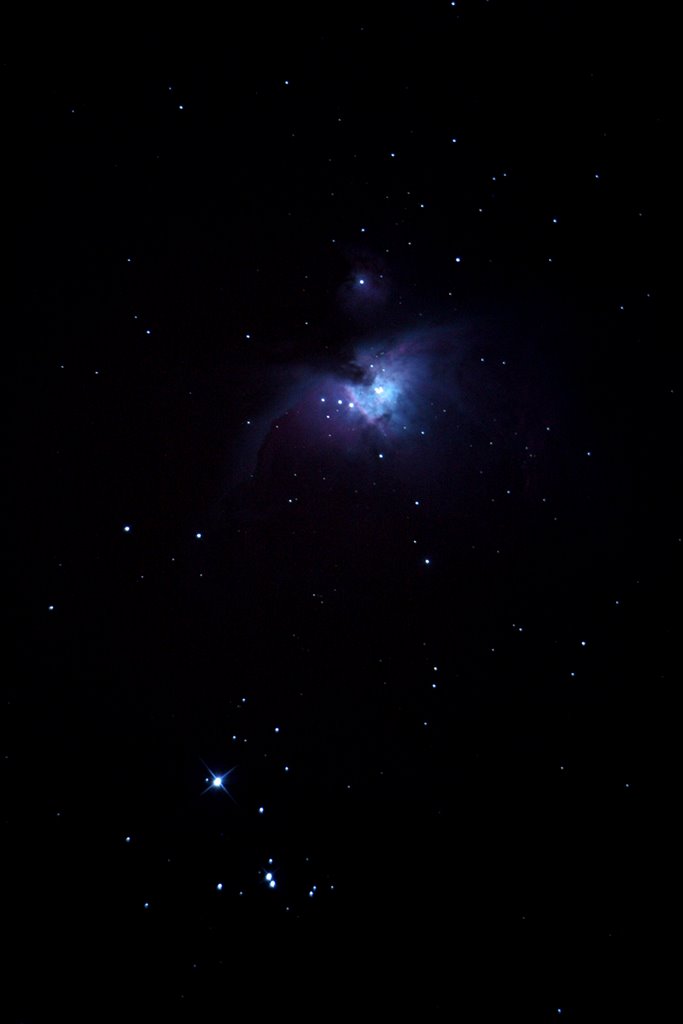
Got a couple of tracked pics of Orion....


Not brilliant at this resolution but shows quite a lot of detail at full res.

Left the scope outside to hopefully get view of Saturn later
Blue skies!

It's been a glorious clear sky all afternoon, so I took the skywatcher outside at 16:30 to get it set up, while waiting for it to get dark enough to get a polar alignment I thought I'd see if I could spot Mercury.

My western horizon is the other side of the hill so I don't get much observing in that direction and there isn't anywhere local that I've found where I'd get an uninterrupted view and can park up.

Anyhow, I spotted Venus with the EB so went to grab the opticron on my camera tripod. Still wasn't really dark enough but by centreing Venus and then roughly tracking back down the ecliptic, bingo Mercury still not visible to the naked eye but quite bright through the scope!

First time I've seen Mercury since I was a youngster.

Hopefully it will keep clear!

cheers
Mitch

Monday, January 22, 2007

Sunday I woke at 5.00am and having looked outside I noticed it was clear, so I decided to avoid the temptation to get more sleep and wait up for Jupiter to rise. By 6.30am the sky had clouded over :o(

Today, at 4.30pm the sky was perfect, but I had work to do, I thought I'd be OK for a couple of hours and anyway Saturn would be a while to rise. By 8.30pm when I had finished working, guess what? More clouds!

I have to get up early in the morning to catch a train at 7.00am so will soon be off to bed as it will be a long day.

later
Mitch

Friday, January 19, 2007

Clouds,

Sitting here at just after 5.00pm on a Friday evening and more clouds, we've had some bad weather across the UK this week culminating in some gales on Wednesday and Thursday. On my way home yesterday I had to go through some flooding and past a large uprooted tree that thankfully had just missed the house next to it and the road!

So no chances for getting the scope out, but this morning it was clear as I left for work at 7.00am and Jupiter looked very grand to the south. If it's clear tomorrow I might get up early and get the Skywatcher out for it's first encounter with an old friend of mine!

Sunday, January 14, 2007

Yep, should have done my homework before trekking off.

Just checked here and it seems I've missed out, the comet would have been too low for me to see it.

Last comet I saw was Hale-Bopp back in 1997.
Comet hunting!

At 4.00pm we still had blue sky but there was a lot of high Cirrus clouds that would make seeing conditions pretty poor.

While it was still clear I decided to jump in my car and go find somewhere where I could get an unobstructed view of the sunset from the comfort of the car! I had to drive several miles before I found somewhere to pull over without getting in anyones way.

The objective was to get a glimpse of Comet McNaught near Venus.

The sun went down and I got some nice views of the clouds near the horizon, should have taken the camera! At approx 4.40pm Venus popped into view and I waited until after 5.00pm but no sight of a comet!

It must be too low in the sky now, I had heavy clouds across the horizon just below Venus.

I need to read up on the viewing prospects, if I get up early for work I'll see if I can see it then.

Mission failed!
Clear sky

OK, so it's only 2.30pm but we have blue sky for the first time in what seems like weeks.

Fingers crossed!

Mitch

Wednesday, January 10, 2007

Well, travelling home from work at 5.00pm today things were looking promising, lovely clear sky.

So, got in fed the dog etc and generally rushed around to get changed and get the scope set up. Polar alignment was a breeze, set the scope aimed at Capella and started tracking while I dashed back into change again, I'd bought some thermals just after xmas so wanted to try out the long sleeve vest (just like my grand father used to wear!).

Rushed back outside again and Capella was still in the centre of the FOV!

Then I noticed the clouds....managed to get a lovely view of the Pleiades with the 40mm EP (25x mag). Then the clouds were everywhere :o(

I only had an hour or so tonight free as I have to do some work after supper!

What a let down, will try to get out later if I get the time and if it clears up of course!

later
Mitch

Saturday, January 06, 2007

OK,

So I decided to not be lazy and went out to see what I could of Saturn. First I just took out the Opticron MM2 with my camera tripod, Saturn was low to the East quite near to the moon but not as close as it appeared with Stellarium. The Opticron zoomed in at max magnification (40x) showed the planet quite clearly, the rings quite easily discernible and overall quite a sharp image.

So tempted I swapped for the Skywatcher, the 40mm EP showed a similar view to the Opticron but as I increased mag the image quality dropped off considerably. I tried the 40mm (25x), the 25mm (40x), 10mm (100x) and the 10mm with the Barlow (200x), next I tried the 25mm with the Barlow (80x) this seemed to be the best combination but the sharpness wasn't a patch on the Opticron. However the Opticron doesn't give a large enough image to be useful.

Having said all of this the seeing conditions were nothing short of attrocious, although I'm not now so impressed with the Skywatcher for Planetary observing. Even taking into account the conditions it will obviously not perform as well as the Opticron for image sharpness at higher mag's. Of course this could well be down to the quality of the standard EP's which themselves seemed to be far better than Meade's.

The standard series of EP's for the Skywatcher seem to cost in the order of £40, the EP for the Opticron (albeit a zoom EP) was £90. So I guess I might need to invest in some higher quality EP's (some sell for £200 or more!).

Anyway, back inside now, I was about to say in the warm, but of course we have been having a very mild winter so far. Hardly any frosts that I can recall, our cricket team should have stayed home rather than tour Australia where we just suffered a 5-0 series defeat in the Ashes series! Worst performance for over 80 years apparently! But that's another story.

More later.
Well, first post of 2007 so Happy New Year to all!

First post because we've had nothing but cloud all over the Christmas break, I had been hoping to get some clear skies while I was off work.

Just noticed that it is clear at the minute but quite misty, we've had rain all day so everywhere is wet, could turn quite nasty if we get a frost!

Due to the poor seeing I thought I'd wait until later to get my first decent view of Saturn through the Skywatcher. Checked with Stellarium to see what time Saturn will be in a nice part of the sky. Guess what? It turns out that Saturn will be very close to the moon for most of the evening :o(

It will probably turn out cloudy soon anyway, the drawback that I've found with having a large scope on a decent mount is that you need to be pretty certain that by the time you get outside and align the scope that it hasn't clouded over.

Thursday, December 28, 2006

Things are looking promising right now, just got the scope setup outside, should be dark enough to get the alignment done in ten minutes or so. Vega is always the first star to appear closely followed by Capella, Polaris isn't bright enough to be seen through the polarscope as yet.

Just checked on Heavens Above and I have 2 passes of the ISS today, first at 17.05 next at 18.40.

Well, the ISS showed right on time, got a very nice view as it crossed the sky, not the brightest of passes but still very impressive.

Next I set to aligning the scope, as I wasn't planning on taking any photos I was happy with a very rough alignment, with the new (xmas present) 40mm EP it takes quite a while to drift.

First target was the Pleiades, the 40mm EP is perfect for this, got the entire cluster in the same FOV, as I was adjusting focus a satellite whizzed by and appeared to increase in brightness as it crossed the FOV.

Next target was Taurus, I'm not sure if it's just me but the Hyades seems almost quite boring as there are practically no background stars in this area of the sky. As I aligned the scope on Aldebarran amazingly another satellite skimmed across the FOV!

As I stood back to look at the whole sky with the naked eye I spotted another ISS like object moving North at a steady pace. Of course it's because it's so close to sunset that I can see these satellites, later on they are not so easy to see (if at all).

Unfortunately that looks like it for now as the moon is merrily lighting up my southern sky and nicely highlighting all the high cloud that is making the seeing conditions not so good. Did get a nice view of Albireo with the 40mm (25x) and 25mm (40x) EP's.

Left the scope set up waiting for Orion, wanted to see M42 through the new EP. Got to 19.50 and Orion was beginning to show his shoulders and...you guessed, clouds started to roll in!

More later

Thursday, December 21, 2006

Well, we've been pretty much fogged out here the last few days, so much that Heathrow airport have cancelled half their flights. The last chance I had to use the scope was last Saturday evening, objective was to test out the recalibrated Polar scope.

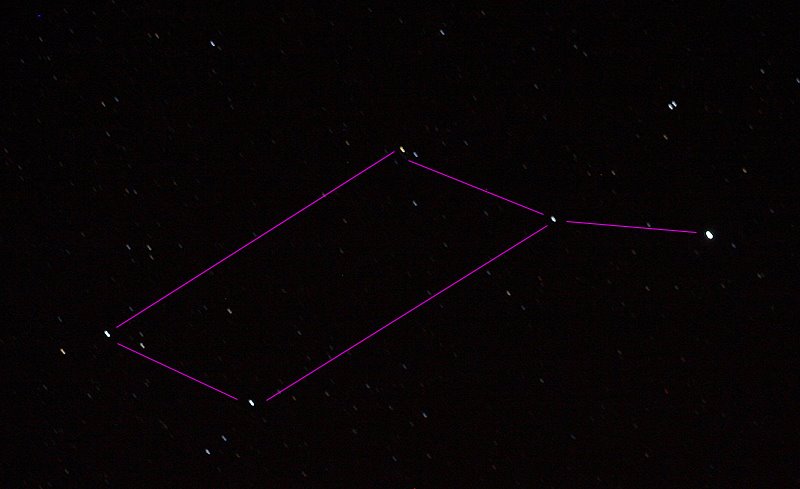
Got the scope aligned fairly quickly and then started with some piggy backed shots, this time I wanted some shots of Cygnus....


Quite pleased with this 10 minute exposure (longest yet), this shows the rear section of Cygnus with Deneb showing nicely, this is a very rich section of the sky as the Milky Way runs through here. The image below has some lines drawn to show the outline of the constellation, Deneb is top right and is in fact the tail star of the swan.


Next I thought I'd have another go at Lyra as it was higher in the sky than last time and therefore out of the glow of light pollution....


Another 10 minute exposure at ISO:400, 35mm equiv 90mm focal length.

Then I tried some prime focus shots and also using the camera attached to the Barlow lens. The Barlow lens seems to have a blurring effect though.

Also I ran into some camera shake again, I've tried everything to eliminate shake. I purchased a 2 metre extension lead for the remote shutter release, this was then isolated by being clipped to a photo stand next to the scope with plenty of slack between the scope and the stand.

I tried shooting with the mirror lock up function also, all to no avail. I've come to the conclusion that there's either a fault with the drive or my patio (made of concrete slabs) has a bounce in it so that as I walk away the scope is picking up vibrations.

Next opportunity I get I will downsize the camera by removing the battery grip and using the camera in its standard configuration.

Just looked outside and...more fog.

cheers
Mitch

Sunday, December 10, 2006

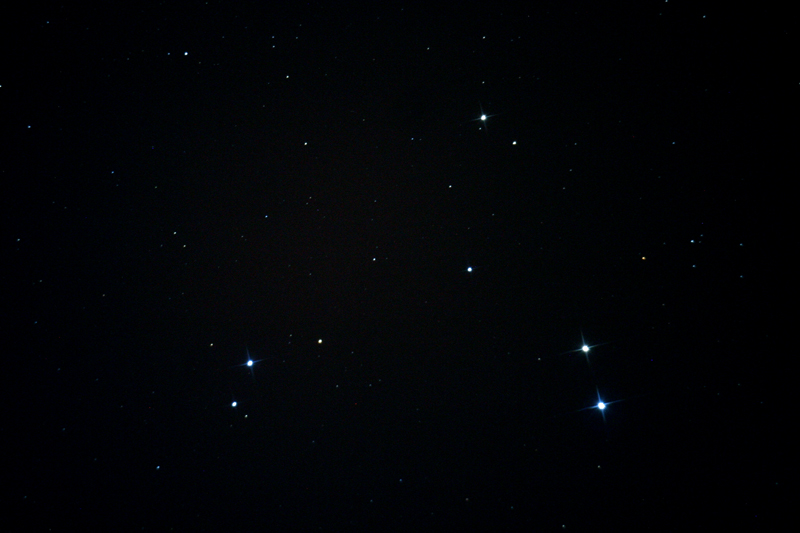
Last night we had a good few hours of clear skies here after a dodgy start with lots of broken cloud. So I had a go at taking some piggy back images, this is basically taking photos with the cameras own lens rather than through the scope but with the camera attached to the OTA. This way you can get wide field images and long tracked exposures, this one is of Lyra....


Canon EOS350D 35mm Equiv focal length 90mm, 200 seconds at f5.6 ISO:400.

Next is the Pleiades....


Same camera setup but 268 second exposure

The next shot was taken in the direction of Cassiopea but due to the dim view through the camera viewfinder it could be anywhere! Lots of stars, though some of the really tiny stars might be just noise!


Same setup with 411 second exposure

This has to be the downside to this aspect of imaging I think, due to the low magnification and the digital SLR's small frame size (compared to a 35mm SLR, it is 60% of that) you can only make out the very brightest of stars in the finder. Also due to the fact that the lens is autofocus even operating in manual mode is tricky because the lens does not have an infinity setting like the old lenses had. I guess part of the solution is to try and get some older non autofocus EOS lenses.

Finally a wide shot showing a part of Taurus including the Hyades....


Same setup with 259 second exposure.

We've had cloud and rain and lots of wind here all day, watched a recording of the shuttle launch from last night, interestingly it seems that whenever the shuttle is docked with the ISS there are no sightings from my location! Must be an amazing sight to see the whole lot going over.

more later
Mitch

Friday, December 08, 2006

Cloud Dodging...

Well it looked like it was clearing up later on so I decided to take the scope out to hopefully get a first look at Saturn with the Skywatcher. As I was setting up the scope Saturn was in view as I'd predicted through a clearing in the clouds.

By the time I was all set to go, you guessed it, Saturn disappered behind the clouds, I missed it by seconds!

So I swung the scope around and had a nice view of the Pleiades and Hyades, and after waiting for what seemed like ages I gave up with Saturn and decided the moon was looking good...as I dashed inside to get the camera the clouds were starting to cover the moon also!

Managed to get a few shots in, here is the best....


More later
Mitch
No clear skies at all since the last post, I'm desperate to get out so I can test the tracking on the scope.

I decided to sell the Meade, put it on eBay and got £155 for it, it would have been nice to have kept it as a travel scope but I just don't have the room to keep it handy. I'd rather someone else get some use out of it.

It was great to read in the news this week about American plans to return to the moon by 2020, it's a shame that as a race we can't just all get along and not waste so much money on killing each other! We'd have surely made more progress in space by now had we not been waging wars both phoney (as in the Cold War) and the many real conflicts.

The irony though I suppose is that it was the cold war that sparked the Space Race and prompted the US to invest so heavily in order that they could prove they were better than the Soviets!

Anyway I digress, this is not a political blog! The OU course has started but I've not had much time to spend on it lately, I have 2 weeks holiday to take over Christmas so I'm hoping to get on with that then. There seems to be a good spread of people taking the course in terms of experience and knowledge of Astronomy.

More later.
Mitch

Wednesday, November 29, 2006

Managed to spend some time outside last night from about 8.00pm on, had a great session taking photos but suffered from wind again, the scope did I mean!

Tried taking some of the Pleiades but the stars kept coming out looking like dumbells......


This I think is due to the scope rocking in the wind, there was only a slight breeze but it seems that is enough to sway the OTA from side to side, I can't think of another reason for this, but if you know better then please let me know!

By the time that I'd failed to get a decent long exposure of the Pleiades I noticed that Orion had risen. Here's another shot of M42, a bit more detail than my first effort so I'm quite pleased with the result.....


Canon EOS350D 35mm equiv focal length = 1.6 metres, 160 seconds ISO400.

Saturday, November 25, 2006

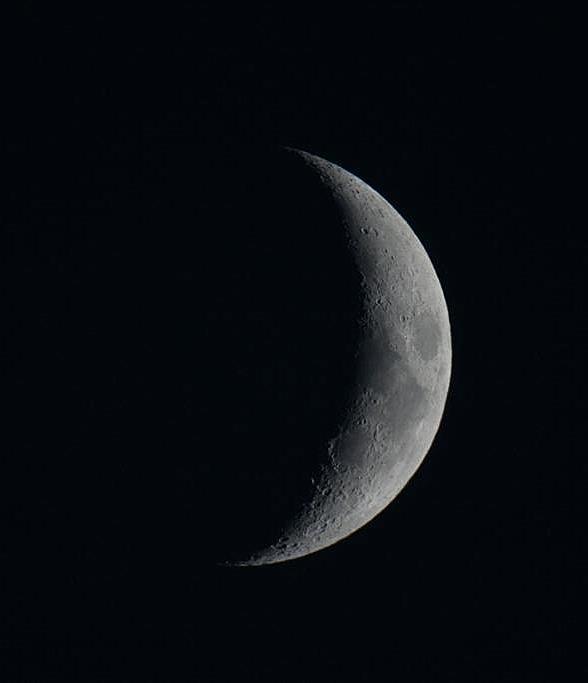
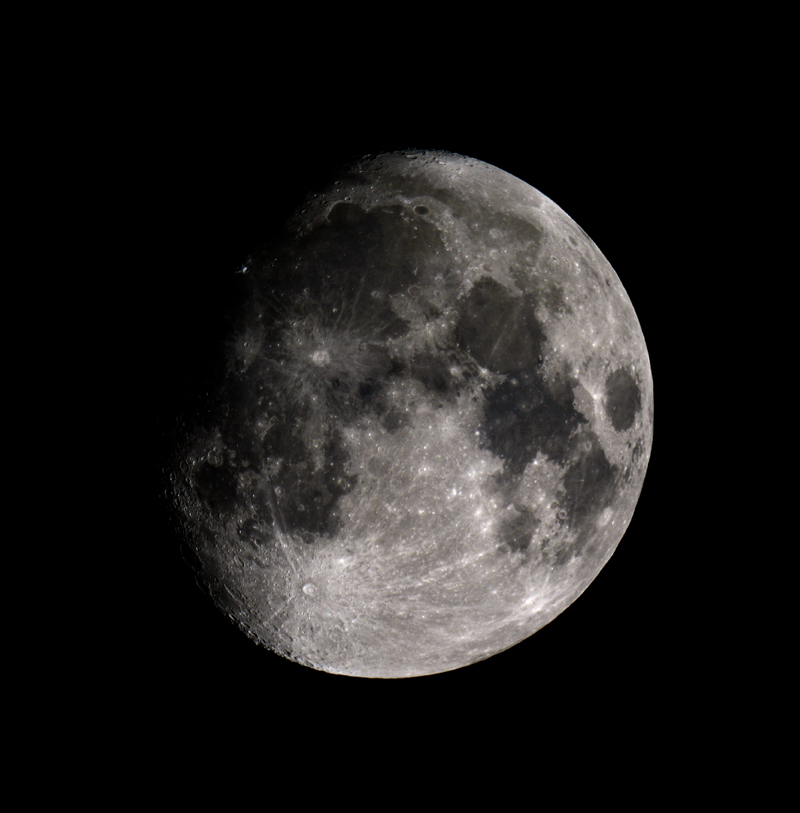
Managed to "grab" a nice photo of the crescent moon at twilight today, I say "grab" because it took a good ten minutes to set everything up, worth it though I think....


Attended the Rosliston Astro group meeting last night, we had a presentation by a chap by the name of Mike Gill who has attended the last 14 total eclipses of the sun, including 1 at Antarctica and one in the middle of the Pacific ocean near Pitcairn Island. Quite an impressive feat, I think that most of the guys in the audience had 2 unspoken questions though, a) If you're married how do you justify the time etc in preparing for these expeditions? and b) How on earth can you afford it?

His trips seem to have been full of long haul flights to places like Australia before embarking on very one off excursions to the middle of nowhere. If it sounds like I'm jealous, off course I am! To most people though this kind of thing is quite simply unobtainable financially so it seems this exclusive club is exclusively for the rich!

Anyway, he did point us in the direction of a certain Glenn H Schneider, who's website is now in my links, quite an individual and a fascinating web site.

later
Mitch

Thursday, November 23, 2006

Went outside tonight at 5.40pm to see if we had clear skies, patchy clouds were around so I decided to have some supper and try again later. Just as I turned my head I saw a very bright object moving to my NNW quite high in the sky almost as soon as I saw it it disappeared and I thought it must have been the ISS. I had checked earlier to see if we had any predicted sightings with a negative answer.

I double checked on Heavens Above, no sightings for tonight were predicted. I then thought it might have been an Iridium flare, again nothing for my time/location.

So no idea what this was, it was very bright, much brighter than anything I've seen before and was a blue/white colour. It didn't look like a meteor and the slow way that it disappeared makes me think it was man made and was entering the earths shadow.

Anyhow, managed to get the scope out for an hour and tried some more photos to prove out the calibration of the mount. So tried for some 3 minute exposures, it seems my problem now though is that I need to get an extension cable for the remote release on the camera. It seems the action of letting go and picking up the controller is giving me camera shake in a big way. This is only a problem when using the "bulb" setting for say a 3 minute exposure. A shorter 30 second shot without letting go of the controller seems ok. But I'm desperately trying to get some long accurately tracked images so that I can pull out more background stars!

Found some extension leads on eBay today so will look at getting one.

Anyway here's a picture of the Hyades open cluster in Taurus....


Tomorrow night is the Rosliston Astronomy group meeting (I think), wonder if we'll get a clear sky again?

Later
Mitch

Sunday, November 19, 2006

Well, today I realised why my polar alignment was always out, I couldn't track anything for more than 30 seconds without getting some form of star trails.

Turned out that the factory alignment of the polar scope with the rotation axis of the mount was out.

So I spent a good half hour with the polarscope centred on the chimney pots of a house about half a mile away and a tiny allen key. Basically the task involved centreing the polarscope then rotating the mount 180 degrees around the R.A. axis. It's when you rotate it that you see the error, if the polarscope was correctly aligned then the centre reticule would stay on target as the mount rotates. Once you see the error you have 3 adjusting screws to set the reticule to what it should be.

In my case it was way out, bit of a fiddly job but the manual supplied by RV Optics had a whole page on how to do this.

Can't wait now to get some longer exposure photos!

The next challenge will be to set up the setting circles so that I can have a manual goto mount!

Just found this site, looks promising......
www.astro-tom.com

Saturday, November 18, 2006

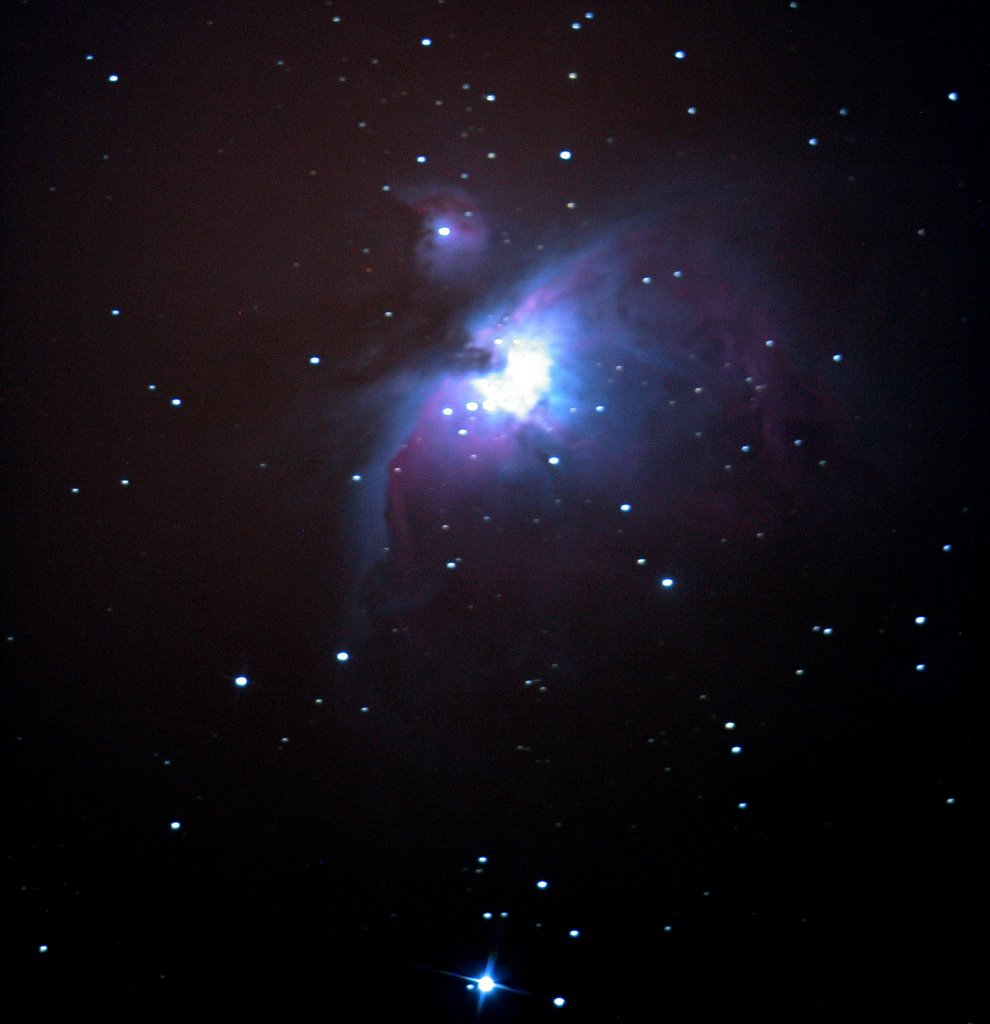
At last a photo of M42....


Quite pleased for a first attempt.

Canon EOS350D prime focus with Skywatcher 200mm Newtonian 15 seconds at ISO:800

Another attempt.....

No more meteors and I suspect there won't be any until 4.00am, so I need to get some sleep.

Did get my first view of Saturn this season though so worth staying up, the rings are closing up so I need to get the Skywatcher out soon to see what I can see.

Bedtime now zzzzzzzzz

Friday, November 17, 2006

Already seen 2 meteors coming from the low Eastern horizon....
Managed to get outside again for some more clear skies, had another look at Beta Lyra through the MM2 now that I've confirmed what I'm looking at, very nice alternative to Albireo! Lyra is a brilliant little constellation through a small scope or Bin's because all but 2 of its stars are doubles.

Just had my first view of Orion since last Winter, Orion was one of the very few constellations that I could see as a child due to light pollution so is always a welcome sight.

A quick look through the MM2 showed some nebulosity in M42, can't wait to get the Skywatcher on the case, but my back is still playing up!

Also had a peek at another old friend, Aldebaran (the eye of the bull if I remember correctly) and the Hyades open cluster.

Am hoping to stay up to see some of the Leonids meteor shower later as it is still clear at the minute and tomorrow is Saturday so no work!

Later
Mitch
It's all Greek to me!

This was once a popular saying in the UK when presented with (to us) meaningless letters etc. I suppose that with other European languages we at least share (some) of the characters, Greek of course is not generally regarded as one of these languages.

Unless you were lucky enough to have received a "classical" education (neither did I) then the custom for identifying the stars of the constellations using the Greek alphabet can be quite a challenge. I've tried to get to know the symbols but I do struggle with most. So I'm adding here the Greek alphabet in order with the generally accepted translations. If there are any Greek speakers viewing this then please let me know if I've made any mistakes....

Just to recap on where this custom comes from, the custom was/is to name a constellations stars alphabetically from the brightest down. So Vega, the brightest star in Lyra is known as Alpha Lyra, Sheliak the second brightest is known as Beta Lyra and so on. I've noticed there seems to be some confusion as to how to spell the constellation here, I have seen some quotes using what I assume to be the multiple form i.e. Lyrae and some with simply Lyr. I'll try to get to the bottom of that.

Anyway, here's the Greek Alphabet, feel free to copy this, print it or whatever you want just so long as it's useful.

I've had a heck of a job formatting this table with html and the blogger editor, so will try to get this fixed over the weekend.

Greek Alphabet

αalphaa
βbetab
γgammac
δdeltad
εepsilone
ζzetaf
ηetag
θthetah
ιiotai
κkappaj
λlambdak
μmul
νnum
ξxin
οomicrono
πpip
ρrhoq
ςsigmafr
σsigmas
τtaut
υupsilonu
φphiv
χchiw
ψpsix
ωomegay

Thursday, November 16, 2006

First clear night for ages! Got outside at 6.30 to see what I could see, I've had a bad back all week so the Skywatcher had to miss out.

First I sat in a deck chair with the Monocular waiting for my eyes to adapt to the dark. Then I tried (again) to see M81 and M82, nothing at all! Out came the MM2 but still nothing, so decided to test the scope on Mizar, the MM2 easily splits the double but not the double double of this famous quartet.

Mizar (the second star in the handle of the big dipper) and its companion are 4 seconds of Arc apart and is a good test for any newcomer with Bin's or small scope.

Next I took a look at Lyra, Vega shining brightly and viewed each of Lyras components, the double double is merely a double with the MM2. Tried to see M57 but not a hope through the spotting scope.

Got a tad confused over Beta Lyra, which through the scope was a double with a blue/white coloured star, lovely to look at. But my book just described it as an "eclipsing variable", not a double so I thought I was looking at the wrong star. According to web sources an eclipsing variable double means the stars are so close that we only know the star is a double by observing changes in luminosity over time. So I'm none the wiser at the minute as to what I was looking at!

A quick look at Albireo was due, as always an excellent sight, looked for M56 half way between Albireo and Beta Lyra, think I found it but not impressive through the MM2 due to its lack of aperture.

Brochi's cluster was nice to see, it just fills the view at the MM2s lowest mag (15x).

Then a quick look to see if I could still find M31, easy once you know where to look! Still just a fuzzy blob though, at least I now know that it stills looks like a fuzzy blob even through a 14" Dobsonian thanks to the astronomy groups last meeting.

The Pleiades look as stunning as ever even through the small aperture.

Later
Mitch

Friday, November 10, 2006

Not been a good week for skies at all....raining outside so far this evening.

Spent some time skimming through the OU course material last night, looks pretty much like the content of some of my books on the subject but they expect you to demonstrate that you have understood the material in an academic way. More on that to come!

Anyway a small item in the news today was that the Cassini probe has photographed the only Hurricane seen so far on another planet, Saturn. I'll bet the guys at the JPL must have had the hairs on their necks standing up when they saw the images for the first time.... saturn.jpl.nasa.gov. The hurricane is at the south pole of Saturn and appears to be stationary, its width is two thirds the diameter of the Earth!

Anyway I need to do some work now...

Later
Mitch

Wednesday, November 08, 2006

Right now the skies are cloudy, but thanks to the internet I'm watching the transit of the Sun by Mercury on a feed from www.slooh.com, strange to see one of our neighbours crossing in front of the Sun.

Of course transits of Venus are much rarer, apperently in 2004 when the last transit of Venus occurred there was no one alive at that time who would have witnessed a previous transit! The next one though is only 4 years from now, they occur in pairs 8 years apart with then a gap in excess of 120 years.

Anyway, I hadn't mentioned before that I'd enrolled for an Open University short science course in.... you guessed it Astronomy. Back in 1989 I started studying for a degree with the OU in Computer Science, this was all about a change of career from being a clerk in the Civil Service to working as a Computer Programmer. I'd spent the previous 3 years studying at the local college all in Computer Science.

Anyway, I got a job as a trainee Analyst/Programmer after my first year's course with the OU. I carried on studying for a further 3 years but pressures in my new career combined with the fact that I was now a practitioner in this subject led to my giving up with half the points needed for a BSc Honours degree.

Back in September I decided to resume my studies to complete my degree, and the OU now offer many more courses than back in 1989. So I've decided to ease my way back into it by doing some short courses in a subject that interests me.

The course material arrived today, I will keep you posted of progress.

I guess an observer on one of Jupiters moons would need a pretty huge scope to see the Earth transit the Sun!

Later
Mitch

Friday, November 03, 2006

Had another clear blue sky all day, nipped outside at just after 5.00pm to wait for a predicted ISS pass due to start at 5.13pm, sure enough there it was, not as bright as Tuesday night but still very impressive. Followed it for much of the way with the monocular, probably just wishful thinking but I'm sure I could just see some detail.

It was a very long track, next time I'll try to time how long it remains visible, seemed to last several minutes for most of which it was heading away from my location.

By this time the dreaded clouds were starting to make an appearance, before they completely ruined the view I tried again to find M81 and M82 using the monocular, failed again. Now these should be easy according my books, I think the problem is that my northern aspect is pretty well light polluted. I guess I'd have to hit them right on the nose with the Skywatcher in order to see anything, but scoping around with an equatorially mounted newt is not at all easy.

later
Mitch

Thursday, November 02, 2006

Another clear night tonight, but by the time I got outside at around 7.00pm the waxing gibbous moon was lighting up the atmosphere almost like a fluorescent light.

I'd decided that I needed to find M81 and M82 NE of Ursa Major, these are described in one of my books as the two brightest galaxies in the sky, can I find them? No! Anyway the moon wasn't helping at all tonight so I did the logical thing and took another photo of it.

It's turned very cold all of a sudden, been very mild for the time of year until this week.

later
Mitch

Wednesday, November 01, 2006

The sky was teasing at dusk, clear blue skies all day and just as it was getting dark, clouds appeared from nowhere! I kept an eye open though and just after 7.00pm it looked like it would be worth setting up the scope.

The polar alignment was getting a bit easier but it's still not perfect, time will tell.

Anyway took a couple of tracked pics of the Pleaides but not that impressive yet..


So then I tried to locate the Double Cluster in Perseus, not an easy task with the scope, actually it's probably easier with the Monocular. After a few minutes I had what looked like a likely suspect.


The problem I have at the minute is that the camera adaptor for the scope actually uses part of the 1.25" EP holder. In order to attach the camera you have to unscrew the EP holder from its base plate and screw the base plate to the T Adaptor for your camera model. This means that swapping from an EP to the camera is not very slick.

So I end up scoping for targets through the camera viewfinder which is quite dim and very difficult to focus unless you have a bright star like Vega to focus on.

I need to find out if I can buy an additional base plate, of course I will probably have to buy a complete EP holder, that way I can switch from EP to camera relatively quickly.

Tuesday, October 31, 2006

Got home from work early today so had time to set up the Skywatcher just before it got dark. I wanted to get some more photos of the moon, 3 shots this time, 1/500th, 1/250th and 1/125th of a second exposure. This time the middle was the best I think.....


While framing this shot I saw a satellite "drop" by the dark part of the moon, always gives me a spooky feeling when I see things moving like that!

Compare this with a similar prime focus shot through the ETX80...the frame dimensions are identical...that means the images appear here as they would if viewed on a film strip.


After taking the photos decided to take a look at the moon with my lowest power eye piece, amazing detail - I will have to try to start finding my way around. Only problem is that even with 2 filters it still dazzles.

Just after that I got a view of what could only have been the ISS this was approx 17:45 and it was way brighter since last time I saw it (because of the work done recently by the Shuttle mission).

Just confirmed with Heavens Above that the pass was at 17:46 from West to East crossing overhead, will definitely need to get some more photos to compare with earlier in the year.

Just after this the clouds rolled in, maybe should have named the blog "cloud watching".

Later
Mitch

Friday, October 27, 2006

A chance purchase on eBay earlier this week obtained a copy of the Webb Society Star Atlas, got a copy for a tenner plus postage. This comes as a collection of some 40 odd pages that are held in clear plastic sleeves in a ring binder. These can be bought from the Society directly by visiting their site.

Because the pages are loose I took 4 to be colour copied and had two pairs of charts laminated back to back. I now have a couple of very rugged star charts of my most common areas of exploration, I'll get some more done soon. That way I can keep the originals nice and clean (and dry).

Anyway, tonight I went along to my local Astronomy Group for the second time.

An apparently rare occurence (clear skies) allowed us to spend some time outside using some scopes that members had brought along. I got to see the double cluster in Perseus through a 14" Dobsonian, amazing view. We also caught a glimpse of Comet Swan and M31.

The meetings are I think well worth attending it's so good to chat with people who share your interests, they start with an overview of the coming months night sky. After the observing we spent an hour watching a DVD about the search for Supernovae.

Just about to have some food then I'll try to get outside to see what I can see.

cheers
Mitch

Thursday, October 26, 2006

First clear couple of hours for what seems like ages, so out went the Skywatcher. And my first target was M57, really struggled with the finderscope and in the end decided to crouch behind the scope and look along the whole OTA, of course the problem then was locking the drive cams without the tube moving!

Anyway, first look through the EP and Bingo! Looked very odd through the EP wasn't quite sure what it was at all except that I knew something odd lurked in the neighbourhood.

Quickly nipped inside to grab the DSLR and hooked it up at prime focus, took a couple of tracked pics at 20 seconds exposure. Errrm, quite chuffed with the result


Canon 350d at prime focus of Skywatcher 200mm Newtonian 20 seconds ISO 400.

M57 is in the bottom right of this photo and looks like a smoke ring to me!

cheers
Mitch

Tuesday, October 24, 2006

First evening since the last entry that we've had a clear night, problem was that it got dark by 7.00pm but I wasn't able to begin to set up the scope until well after 8.00pm!

Took an age to align the scope and then it wasn't perfect :o(

Managed to get in some views of the Pliaedes but at my lowest power EP can't fit the whole view in.

Having trouble wth he keybard at theminu so ll updat later

Friday, October 13, 2006

What started as a promising evening turned out cloudy again.

Initially, as twilight was falling it looked very promising, then it looked like this mornings fog was returning, then it cleared again.

So deciding that one must make the effort even though after a tough week at work I just felt like doing nothing...I carted out the Skywatcher.

After failing miserably to polar align the scope I decided to scan the sky to see what I could see. But to be honest that sort of observing is rarely productive in my experience.

In the end I noticed that the Pleaides were rising so I decided to set up the camera to try my first photos of the Seven Sisters through the new scope. I got in a couple of shots but by the time I had decided on a shutter speed and orientation of the camera frame, guess what?

The Pliaedes had disappeared behind a huge bank of cloud that had crept up from the south! Mission aborted for now!

Later
Mitch

Tuesday, October 10, 2006

Late yesterday afternoon the sky was as clear and blue as it has been for a long time, as the sun went down though some high cirrus clouds started to drift in. Next the waning full moon made an apearance. All in all not ideal conditions for setting up the scope.

So I decided to take the camera out to see what I could get n terms of static photos.

First up was Lyra...


Next was Cygnus....


Then Cassiopeia....


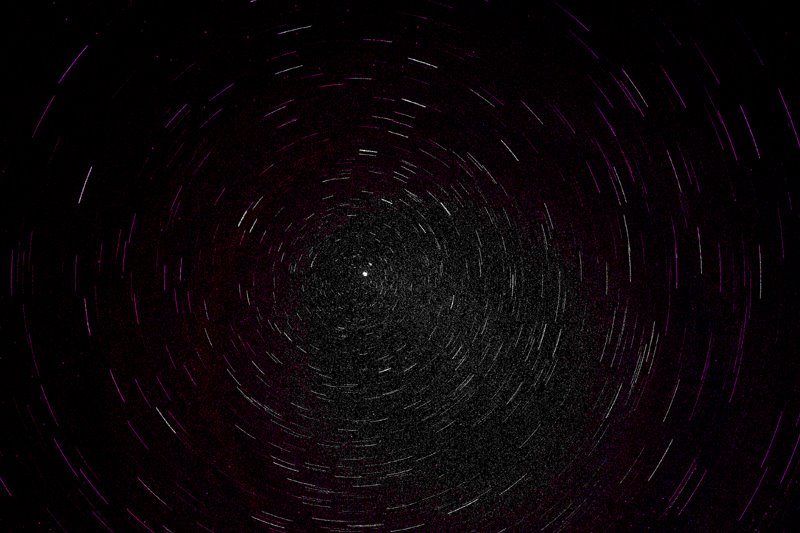
Finally, I've always wanted to try one of those photos where the stars trail around Polaris...


This final picture was a 30 minute exposure, and it took nearly another 30 mins for the camera to process it. After all that there was a lot of noise, the image above was after post processing in Photoshop to reduce noise and adjusting levels.

Wednesday, October 04, 2006

First clear night for weeks and I had to go out to a social event with work! Got home around 10.30 and managed to drag the skywatcher outside, by this time though the moon was beginning to spoil most of my visible sky.

Only one thing for it then, take my first look at the moon through the new scope, awesome is the word, and that's through the lowest power eyepiece. Next task then was to see how much of the frame is filled with the camera?


Canon EOS350D, ISO:100, 1/500s, 35mm equiv focal length 1600mm.

I'm quite pleased with the result! I've cropped some blank sky to the left as the moon had drifted between shots and was thus to the right of the frame, but the vertical proportions are as is. I took a dozen shots and bracketed all the way between 1/60s to 1/500s.

Off to bed now as work in the morning :o(

Mitch

Saturday, September 30, 2006

I was just reading about supernovae etc and it struck me, when we see stars explode and we all think "wow look at that", we may be witnessing the extinction of a civilization.

Depressing or what?

Friday, September 29, 2006

No clear skies at all since last week.

Tonight I went along to my local Astronomy group meeting for the first time, it was nice to spend a few hours in the company of people who share this interest. I'd definitely recommend doing this for anyone interested, there seemed to be a real mix of levels of experience which means there's always someone to give you advice without you necessarily feeling like a complete novice.

With the absence of a clear sky we spent an hour watching some documentaries of Astronomical interest before heading for home.

Later
Mitch

Friday, September 22, 2006

After a rainy afternoon I was quite pleased to see some clear skies tonight.

Took the Skywatcher outside around 10.00pm but high clouds again spoilt the view. I did manage to get a glimpse of the double cluster, the increase in aperture from 80mm (on the Meade) to 200mm made this an amazing sight through the scope!

Just as I spotted the Pleiades a meteor flashed by them! The seven sisters were quite low in the sky but the Skywatcher easily showed lots of detail though I couldn't the complete cluster using the 25mm EP. I am thinking about buying a lower power EP, say 40mm, for this kind of observing.

When the Pleiades are higher in the sky I will try to get some long exposure photos, I have high hopes for that.

That's all I had time for last night what with the clouds etc.

Later
Mitch

Sunday, September 17, 2006

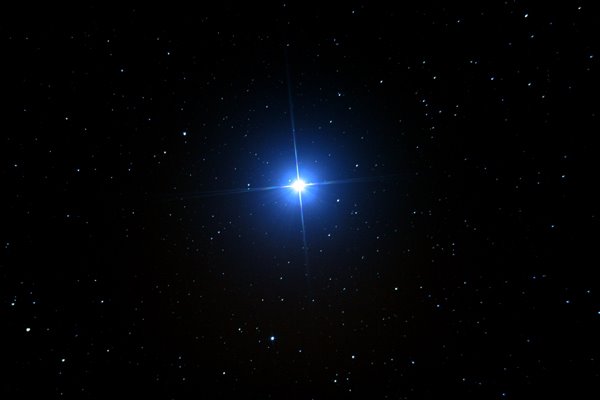
No chance for any clear skies since Friday. Ian, I tried to reply to your comment, without success. The photo of Vega was taken using a Canon 350D SLR attached to my newly aquired Skywatcher 200mm Newtonian reflector on its HEQ5 motorised mount. The equivalent 35mm focal length would be 1600mm and the aperture of the scope works out at f5. The photo was a 2 minute exposure using the HEQ5 mounts motor drive to track the sky.

cheers
Mitch

Friday, September 15, 2006

Well, as it got dark the high cirrus clouds rolled in yet again. I had moved the Skywatcher outside before it got dark so was disappointed again. Then a clear patch revealed Polaris so I decided to have a go at aligning the HEQ5 mount.

I had been quite apprehensive about this, the instructions that came with the scope were very good but I was still struggling to get my head around some of it. I resorted to running Stellerium and choosing the "Equatorial mount" view, all became clear as to how it should work!

So tonight I bravely got on my knees to peer through the Polarscope and managed to align the mount. I will post some tips on this at some point, assuming that I succeeded...anyway, due to the poor seeing I decided to try out the camera mount with the mounts' tracking ability.

After a few attempts I managed to get this image of Vega....


This 2 minute exposure would appear to prove that the scope was aligned sufficiently for this exposure length :o)
Well, it looks very promising at the minute, not a cloud in the sky! Problem is that it's at least a couple of hours until darkness.

More later, hopefully.

Mitch

Tuesday, September 12, 2006

Well, last night was a total wash out on account of thunderstorms circling the neighbourhood.

Tonight has not been much better with lots of cloud crossing from the South West to the North East.

The new scope may have to wait a few weeks before I get some decent viewing.

Mitch

Sunday, September 10, 2006

Last night was another lunar washout, I spent some time looking through the Skywatcher but the sky just wasn't dark enough to do much so I threw the towel in and watched one of my favourite movies "Contact". The film is based upon the book of the same name by the late Carl Sagan.

Today I've just got back from a visit to the Jodrell Bank Observatory, it's roughly a 50 mile drive each way from where I live. The planetarium has been demolished as well as most of the visitors centre. They are apparently starting work on an all new planetarium and exhibition etc.

Here's a nice pic showing the star attraction....

Friday, September 08, 2006

It's looking like a clear night tonight and am I glad, just been to fetch my new Skywatcher 200mm Newt on the HEQ5 mount Smile

Drove up to Sheffield to Rother Valley Optics, impressive little shop with some serious gear, the uy runnig the place obviously knows his stuff.

Got home and started the assembly process.

It looks like I'm in for a steep learning curve with these Equatorial mount thingies, all looks greek to me so far!

Initial testing of the optics on distant terrestial objects looks good.

First tips I need is how to transport the whole thing outside without getting a hernia Surprised

So far the best way seems to be to remove the OTA, then remove the balance weights that seems to make the tripod moveable. My only worry is that replacing the OTA seems a tad fraught, I'm worried about dropping it before I manage to tighten the locking screws.

Well, not a bad first night, in spite of the high cloud and the full moon.

The 200mm Newt certainly picks up faint stars and I almost blinded myself by looking at the moon without filters on the EP!

I didn't get around to aligning the mount but concentrated on finding how it all works manually to start with, then used the motor drives to fine tune things. The motors are so quiet that at first I didn't realise they were working!

My only complaint so far with the scope is that it seems one of the tube rings must have a rough edge on it, and while adjusting the OTA for balance etc. I have acquired some nasty scratches on the tube Sad

Other than that I'm quite chuffed with my choice Smile


Thursday, September 07, 2006

There was a partial Lunar eclipse this evening, but, the moon was out of view for me until the excitement was over.

By then I was in my reclining chairhoping for some eyeball astronomy but the full moon was by then washing out most of the sky.

Tomorrow I'm hoping to get my new scope and obviously have a play with it, but it looks like it will mainly be the moon will be my first target!

Later
Mitch

Sunday, September 03, 2006

Bought the September issue of the Sky at Night magazine this morning, so after reading that Neptune and Uranus are on view this month I decided to see what I could see.

So just as twighlight fell I was outside to take a look.

Got my first view in a while of Jupiter as it sank in the west, due to the low altitude I didn't see much other than the main moons.

The moon was bright to my south, which is where I was looking for the aforementioned planets, thanks to the moon and scattered cloud tonight's mission was not accomplished, my southern horizon is not good at the best of times. But I have a few weeks yet to see them, these will be a first for me, never saw them as a child like I did with Jupiter and Saturn, they are like old friends to me now!

Anyway, did get to see Lyra and Cygnus again along with Cassiopeia and of course Ursa Major. Albireo was a nice sight as always and the monocular gave a nice view of the doubles in Lyra but not of course the double double.

Earlier in the week I decided to upgrade the Meade ETX80 with something a tad more serious. This time I am refusing to be seduced by GOTO features and concentrate on aperture and a serious mount. After some advice I've decided to go for a Skywatcher 200mm Newt on a heavyduty motorised mount. At a price of £539 this looks like a bargain after I paid £300 for the Meade.

I was almost in the car on a 65 mile trip to the shop to buy this yesterday when I decided to check availability, that turned out to be a good call, the mount is out of stock until the end of the week. So hopefully this time next week I'll be the proud owner of a new scope. I will try to sell the Meade on eBay as I don't have the space to keep it as well as the new kit.

Tuesday, August 29, 2006

For the first time in ages I managed to make sure that I acclimatised my eyes properly, and on such a clear night it was well worth the effort.

I dragged out of the garage an obsolete reclining office chair and a footstool and leant back with my feet up for a good hour using the Mark I Eyeball aided occasionally by my Opticron Monocular.

Probably my most rewarding night's observing in a long time. Lyra and Cygnus were very clear and I could just make out the Milky Way running through that part of the sky, no mean feat where I live!

Looking through the monocular in these areas was breathtaking, countless numbers of stars!

I also had my eye on Cassiopiae and Perseus, the double cluster was a nice sight again.

For the first time I was able to spot the Andromeda galaxy with the naked eye!

Then, the Mrs turned on the bathroom light!

I was only today telling someone at work that you don't need to buy lots of kit to enjoy the night sky!

cheers
Mitch

Monday, August 28, 2006

Clear skies tonight :o)

Due to my restricted viewing at my location I've decided that I need to concentrate my observing on getting to know my particular piece of the sky better. Number one on my list has to be Cassiopiae and the multitude of clusters etc around it.

Interestingly it's an immediately identifiable constellation, but, when viewed through an eyepiece of any magnification I can't make head nor tale of it, I must need to use a ultra low powered instrument methinks.

The Monocular has now been tripod mounted due to some eBay purchases of Manfrotto clamps. I got a great view of Brochis cluster (coat hanger) tonight with this low powered intrument. Also some nice sweeping views through Cygnus and Lyra.

Incidentally tonight was probably my first proper view of Lyra as a constellation, last autumn/winter it was lower in the sky and thus obscured by light pollution.

Anyway, whilst getting my eyes skyworthy I noticed what seemed to be the ISS cruising from North to South across my zenith. Yet 5 minutes later, I saw another candidate for the ISS cruising in the opposite direction! The second satellite must have gone behind some high cloud because it dimmed considerably before suddenly brightening again.

The highlight of tonight though....I watched a meteor pass overhead from NW to SE through Cygnus and it was a sight! There was a definite smoke trail and it brightened a few times although I saw no debris falling away. It seemed to last forever but probably only lasted 15 seconds or so.

Anyway, a good start to the new observing season for us lackies who can't be bothered to stay up all night through the summer.

Later,
Mitch

Saturday, August 26, 2006

Well, took a look outside at 22.30 BST and the sky was clear so I took the Meade out to take a look around only to see, more cloud :o(

Thursday, August 24, 2006

Well, nice clear night but not perfect seeing conditions...

Nice view of my favourite , Albireo.

Generally scanned the area around Cygnus with the Meade, lots of background stars in this area. If I lived in a dark sky area I'm sure this would be breathtaking to the naked eye. But for me, just tantalising glimpses of the Milky Way.

As I turned the scope around to the NE I saw a meteor flash by Cassiopeia, so I decided to look for some of the clusters to be found there.

Amazingly as I looked through the scope I saw a satellite moving quickly across the sky and decided to follow it through the scope. As I followed it I chanced upon the double cluster of NGC869 & 884.

I suppose my attraction to astronomy has always been a sense of a spooky feeling and the hairs on my neck moving when I realise just how far away things are, these clusters are 7,000 light years away. Of course that means that these stars might not actually exist now, because we are actually staring into the past. We see these stars as they looked 7,000 years ago, that's quite a long time in human history (if not most of it).

Anyway, not a bad night's viewing for my first of the "season".

Later
Mitch
Looks like a decent night for some observing at last. Just had the best view of the ISS so far, the track lasted for over 6 minutes and was very bright!

Will try to get out again soon with the scope to see what I can see.

Mitch

Friday, August 18, 2006

Just got my first view of the ISS for quite some time, followed it though the BGA Monoscope no detail visible, but I was able to watch it until it was quite faint before finally disapearig into the Earth's shadow

Quite a short track this time, from the south west as predicted by Heavens Above and disappeared south of Cygnus.

Quite cloudy though with clear patches to the south, we have had our first rain in weeks over the last few days.

Getting back into this after a dry spell!
Well, it's been ages since I last had a view of the night sky. Sitting here now at 9.00pm and it's dark outside and just caught a glimpse of some stars.

Another few weeks and I'll be getting back into some star gazing I reckon.

More later

Mitch

Friday, May 26, 2006

Just managed to spend 20 minutes outside while it's getting dark, Jupiter is still to the south with the Gallilean moons strung out in a line with one to the SW and the rest in a nice line to the NE. Cloud belts only just visible due to lotsof high cloud.

Albireo shoul be visible to my east but obscured by cloud.

The plough is directly overhead and that's about it for now, will try later.

Tuesday, May 23, 2006

Well, today I received my new Opticron 10x42 monocular so was desperate to try it out on a night sky. Jupiter is just visible in the southern sky right now so went out to see what my new purchase made of it, as it was still very much twilight the moons were not visible but could clearly see Jupiter as a disc. Just as I got a focus it started to rain, we have had rain every day for what seems like 2 weeks now!

You may well ask why a monocular rather than bin's? Well, basically I don't have full use of my right eye, a defect from birth. So bin's are a waste for me, the Opticron BGA 10x42 is so far looking like a worthwhile addition to my armoury but I think a tripod mount will be required. I had hoped that I could get away without that.

I bought this item with a view to using it for low power viewing of subjects like M42 and general star clusters. The Opticron's optics are first rate so the small aperture easily out performs some scopes with larger apertures but with cheaper optics in a similar price range justified by goto computers built in.

Tuesday, May 16, 2006

Very frustrating at the moment, but, I'm so busy with other stuff that the lack of observing opportunities is a blessing in disguise!

I'd forgotten that Astronomy is a difficult hobby in the spring/summer months if you have to get up for work in the mornings. So have had very little chance to see much, however, Jupiter is sitting right in view of my front door due south after 9.00pm BST. Just had a quick peek with the Opticron, 3 moons to the south west and 1 to the north east very close to the planets body. Haven't had time to look up which is which.

Rest of the sky is currently cloudy so not looking promising tonight.

So, rather than snatching an hour after work in December if it's a clear sky, I'm faced with trying to plan a late night vigil just to see if the sky is clear!

cheers
Mitch

Tuesday, May 09, 2006

Well, this astronomy thing is full of opposites, right now at 22.20hrs BST the sky is just darkening and Jupiter is nicely visible, if a tad blurred by its low angle in the sky.

It's also quite warm compared to a similar observing situation back in December, but of course I have to get up for work in the morning. It seems that those who make the most of the warm weather for observing must be either unemployed or retired :o(

Wednesday, May 03, 2006

Just had my first clear view of the night sky in ages, stepped out of my front door and directly in front of me to my south is Jupiter. The opticron quickly showed the 4 main moons and could just make out 2 cloud belts.

Hopefully more later, but work in the morning.....

Saturday, April 08, 2006

No clear skies since the last post, not doing very well at all lately.

I have though just bought a boxed set of DVDs of the TV mini series "From the Earth to the Moon", only just been released in the UK on DVD, I missed this on TV so spent a good 12 hours glued to the TV over the past 2 weeks.

I was very impressed in how they reproduced the mood and the look & feel of the late 1960's/early 1970's. Having said that I was a tad disappointed with some of the episodes, having read Neil Armstrong's bio I was expecting a tad more factual stuff but I guess they just wouldn't have had the time.

Overall though it was worth the money.

Monday, April 03, 2006

Just looked outside and the sky is clear, so ran outside with the Opticron to get a nice view of the waxing crescent moon, a couple of craters stood out most impressively along the terminator.

The Pleiades are fairly low to my north west and not as impressive as on earlier observations when to the south. Orion is way around to the west and Arcturus is very bright to the East.

Overall seeing conditions are not very impressive though, will try again later.

Saturday, April 01, 2006

First clear night in weeks, OK not exactly clear, but I did get a nice glimpse of Saturn which is now high in the south. Orion and Sirius have moved quite a way westward since my last sighting.

Cassiopea was low to the north and the Plough was on its side to the north east.

The crescent moon looked impressive with quite a bit of earthshine lighting the shadow.

That looks like it for now, will check later to see if the cloud has cleared.
Still no clear skies since the last post, it's been a windy day and I'm now looking at some blue sky. Plenty of cumulus clouds crossing to the south, I wonder if it can stay clear until it get's dark which is a good couple of hours away now that we are in Daylight Saving Time.

Fingers crossed.

Saturday, March 25, 2006

Well, another week has gone by with no observing opportunities. I thought I was in for some clear skies mid week, caught a glimpse of Sirius through the haze of some high clouds but the sky was overcast within minutes!

Saturday, March 18, 2006

Stop the press, I just looked out of the window and saw the moon! And........., it is hidden by intermittent cloud.

That's been it since the last post!

Saturday, March 11, 2006

Well, not a single star since last Monday, it's been overcast and we've had plenty of rain which occasionally turns to sleet or snow.

Somewhere I have photos of a visit to Jodrell Bank, if I can find them I'll post some.

Tuesday, March 07, 2006

First time since Tuesday of last week that we haven't had a clear sky here.

I have too much to do at the moment to make the most of the clear nights, but it makes you think that you should make the most of every clear night when they're available.

Monday, March 06, 2006

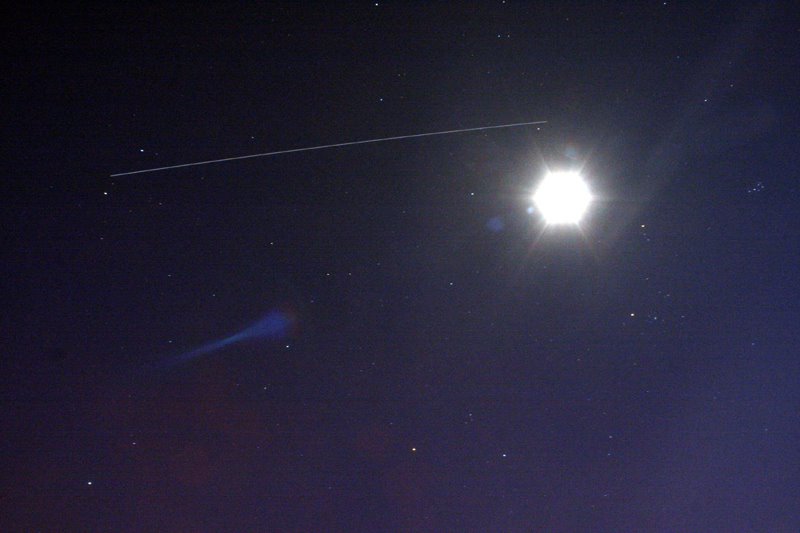
Had another chance to photograph the ISS this evening, got a longer exposure this time (thus a longer track). I must try to get back to some proper astronomy now!


Of course this shot might have been better if the moon wasn't in the way, or would it?

The ISS is passing from right to left.

Immediately to the right of the moon is Mars. Farther to the right of the moon you can see the Pleiades and just below and to the right of the moon is Taurus.

The ISS disappears (in this photo) between Castor and Pollux in Gemini.

The hexagonal shape of the moon is caused by the iris leaves on the lens because I'd stopped it down to f11 to try to avoid over exposure of the sky in general.

Canon EOS 350D ISO:800 33 seconds at f/11.0

Sunday, March 05, 2006

Another successful track of the ISS at 18:26 tonight, watched the whole of its' track across the sky as it skimmed by the moon, probably the brightest I've seen it so far at a magnitude of -0.6.

Tried to view another Iridium flare without success though, must read up some more on these to ensure I'm looking in the right direction.

Clouds are rolling in again now but will try to get outside later if i can.

Friday, March 03, 2006

Clear blue skies all day today after what was apparently the coldest March night in the UK since the 1960's.

I had planned to attempt my first sighting of an Iridium flare, all set for 19:03, but the clouds had rolled in, so back inside. I had also made a note of the ISS pass, and by sheer luck I thought to nip out to see if it was still cloudy without a thought for the time. Bingo, there she was high overhead and dispappeared after passing through Gemini!

More later, hopefully!

Thursday, March 02, 2006

Another clear sky!

I had an ISS track forecast for 18:47 tonight from the WSW. So, set up the camera early but noticed the thin crescent moon that I'd missed last night was on show with a nice amount of earth shine lighting the shadow. So took a few heavily bracketted shots of this first.

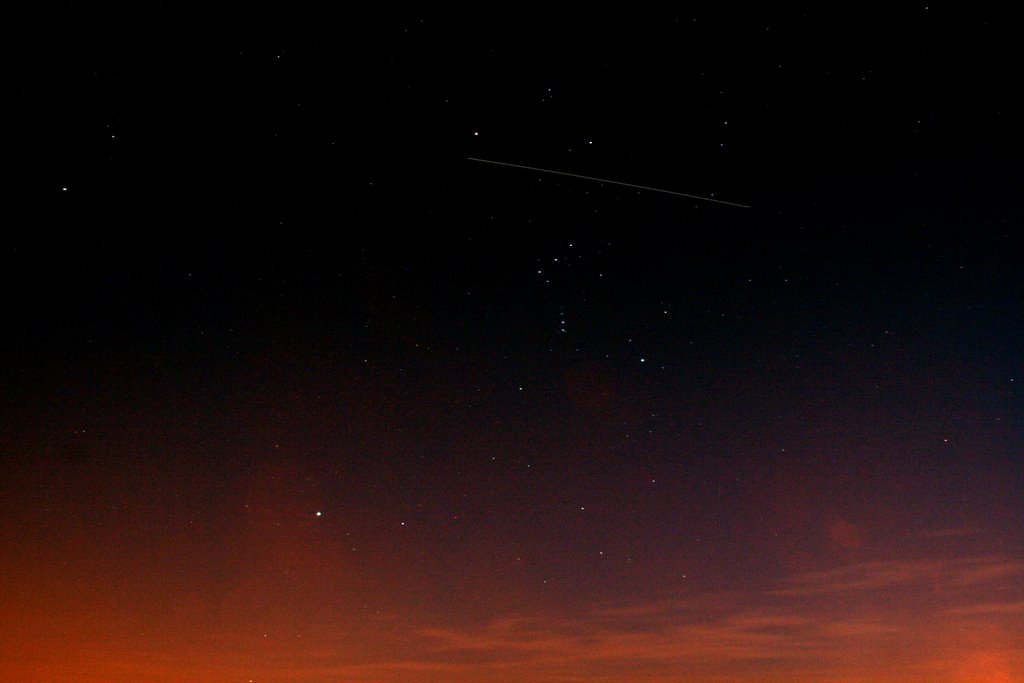
Then back to the ISS, sure enough it showed right on time, the following images are variations of my second attempt to capture it on "film". This shot was made with a Canon EOS350D using a 35mm SLR equivalent focal length of 28mm, exposure was 24 seconds at f8.0, speed 800 ISO.


Only had chance for one shot, problem is that the stars etc are so faint through the viewfinder, so didn't start the exposure as soon as I could and I wasn't sure if the ISS was out of view. Next time I will try to get more shots in. The photo above is "as is" from the camera.


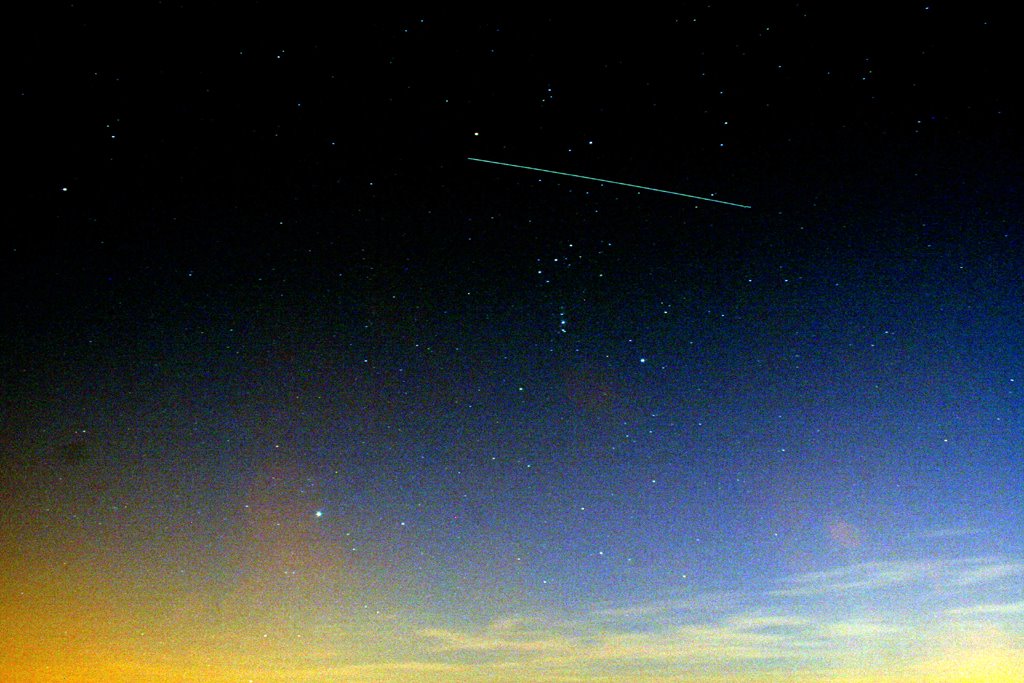
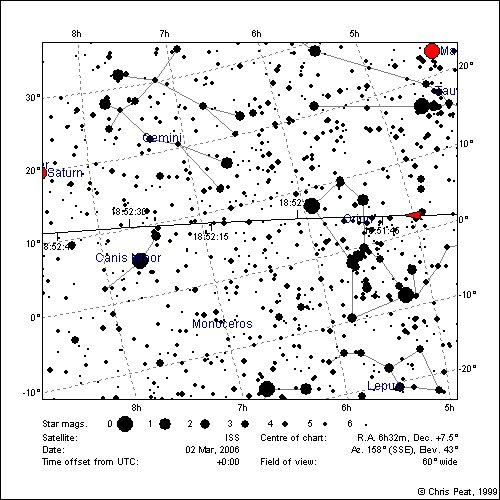
This version is after adjust levels in photoshop, interesting that you can now see the atmosphere in daylight. The ISS is the long streak crossing Orion. Below is the forecast plot for this pass from heavens-above, I'd say the prediction couldn't have been better!

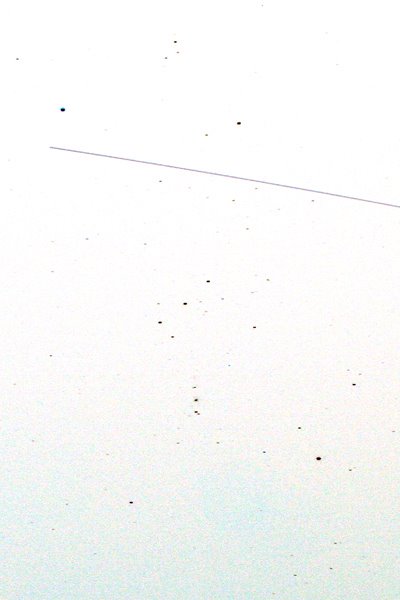
The predicted track of the ISS is shown by the solid line running right to left with a red arrow near its' beginning. Below is an inverted version of the final image as a comparison to the chart.


This is a cropped version of the same shot, must try to get some observing done while I have the chance.

Wednesday, March 01, 2006

Another clear evening, although after a long day at work I wasn't feeling up to much tonight.

However, I'd used Heavens Above to predict an ISS siting from my front door at 18:32 GMT. So set up the camera with a wide angle lens and a bulb shutter setting.

Sure enough, the ISS showed on time and was visible for much longer than yesterday, way past Orion and into the distance before it disappeared. Quite spooky really.

So, rushed back in and loaded the image to the PC, I could just make out the track, problem is I think that it was too light, Orion was barely visible at this time. Therefore contrast etc. meant the track wouldn't show. The problem with getting long exposures correct is a trade off of time versus light, to avoid overexposure you compensate normally by stopping down the aperture, doing that in this case means the track is very faint. Never mind, I will try again, especially as I have got the hang of watching for it coming.

BTW in order to use the Heavens Above predictor correctly you need to enter your location, which is quite easy as a list of towns is in the database.

Also had a quick look at Orion, Saturn and started to see some of the clusters low in the southern sky but these will take a lot of work I think.

Found out tonight that Arcturus in Bootes is the 4th brightest star in the Northern sky, it certainly was bright last night.