Thursday, November 23, 2006

Went outside tonight at 5.40pm to see if we had clear skies, patchy clouds were around so I decided to have some supper and try again later. Just as I turned my head I saw a very bright object moving to my NNW quite high in the sky almost as soon as I saw it it disappeared and I thought it must have been the ISS. I had checked earlier to see if we had any predicted sightings with a negative answer.

I double checked on Heavens Above, no sightings for tonight were predicted. I then thought it might have been an Iridium flare, again nothing for my time/location.

So no idea what this was, it was very bright, much brighter than anything I've seen before and was a blue/white colour. It didn't look like a meteor and the slow way that it disappeared makes me think it was man made and was entering the earths shadow.

Anyhow, managed to get the scope out for an hour and tried some more photos to prove out the calibration of the mount. So tried for some 3 minute exposures, it seems my problem now though is that I need to get an extension cable for the remote release on the camera. It seems the action of letting go and picking up the controller is giving me camera shake in a big way. This is only a problem when using the "bulb" setting for say a 3 minute exposure. A shorter 30 second shot without letting go of the controller seems ok. But I'm desperately trying to get some long accurately tracked images so that I can pull out more background stars!

Found some extension leads on eBay today so will look at getting one.

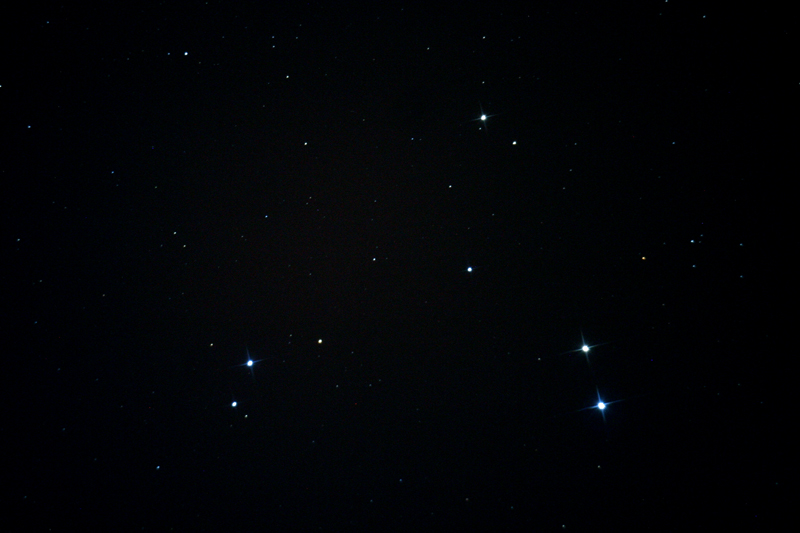
Anyway here's a picture of the Hyades open cluster in Taurus....

Tomorrow night is the Rosliston Astronomy group meeting (I think), wonder if we'll get a clear sky again?

Later
Mitch

Sunday, November 19, 2006

Well, today I realised why my polar alignment was always out, I couldn't track anything for more than 30 seconds without getting some form of star trails.

Turned out that the factory alignment of the polar scope with the rotation axis of the mount was out.

So I spent a good half hour with the polarscope centred on the chimney pots of a house about half a mile away and a tiny allen key. Basically the task involved centreing the polarscope then rotating the mount 180 degrees around the R.A. axis. It's when you rotate it that you see the error, if the polarscope was correctly aligned then the centre reticule would stay on target as the mount rotates. Once you see the error you have 3 adjusting screws to set the reticule to what it should be.

In my case it was way out, bit of a fiddly job but the manual supplied by RV Optics had a whole page on how to do this.

Can't wait now to get some longer exposure photos!

The next challenge will be to set up the setting circles so that I can have a manual goto mount!

Just found this site, looks promising......
www.astro-tom.com

Saturday, November 18, 2006

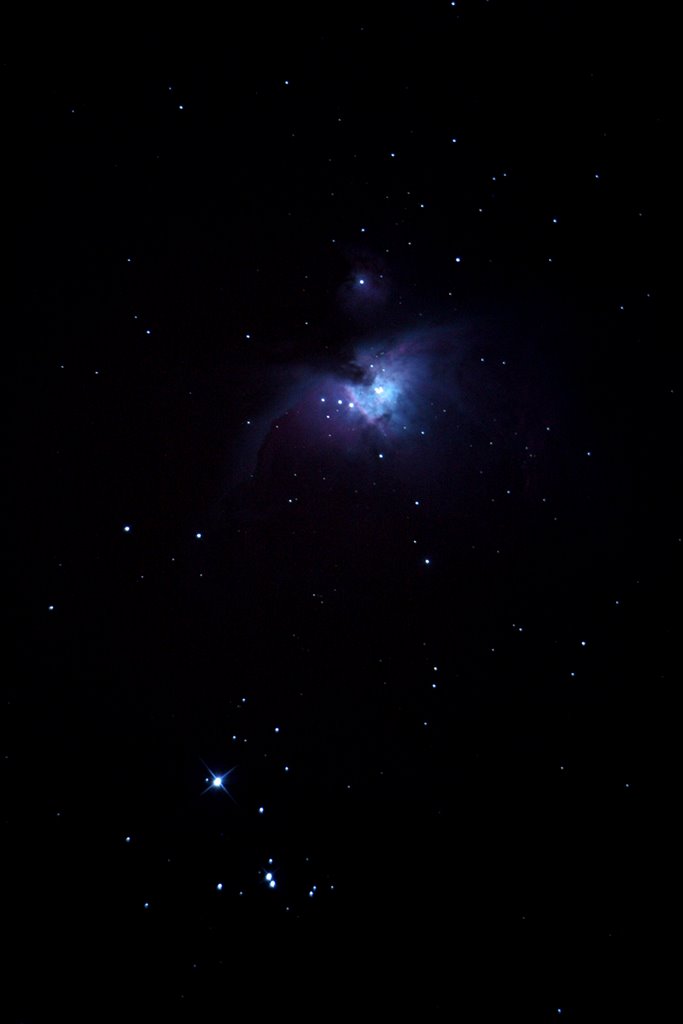
At last a photo of M42....


Quite pleased for a first attempt.

Canon EOS350D prime focus with Skywatcher 200mm Newtonian 15 seconds at ISO:800

Another attempt.....

No more meteors and I suspect there won't be any until 4.00am, so I need to get some sleep.

Did get my first view of Saturn this season though so worth staying up, the rings are closing up so I need to get the Skywatcher out soon to see what I can see.

Bedtime now zzzzzzzzz

Friday, November 17, 2006

Already seen 2 meteors coming from the low Eastern horizon....
Managed to get outside again for some more clear skies, had another look at Beta Lyra through the MM2 now that I've confirmed what I'm looking at, very nice alternative to Albireo! Lyra is a brilliant little constellation through a small scope or Bin's because all but 2 of its stars are doubles.

Just had my first view of Orion since last Winter, Orion was one of the very few constellations that I could see as a child due to light pollution so is always a welcome sight.

A quick look through the MM2 showed some nebulosity in M42, can't wait to get the Skywatcher on the case, but my back is still playing up!

Also had a peek at another old friend, Aldebaran (the eye of the bull if I remember correctly) and the Hyades open cluster.

Am hoping to stay up to see some of the Leonids meteor shower later as it is still clear at the minute and tomorrow is Saturday so no work!

Later
Mitch
It's all Greek to me!

This was once a popular saying in the UK when presented with (to us) meaningless letters etc. I suppose that with other European languages we at least share (some) of the characters, Greek of course is not generally regarded as one of these languages.

Unless you were lucky enough to have received a "classical" education (neither did I) then the custom for identifying the stars of the constellations using the Greek alphabet can be quite a challenge. I've tried to get to know the symbols but I do struggle with most. So I'm adding here the Greek alphabet in order with the generally accepted translations. If there are any Greek speakers viewing this then please let me know if I've made any mistakes....

Just to recap on where this custom comes from, the custom was/is to name a constellations stars alphabetically from the brightest down. So Vega, the brightest star in Lyra is known as Alpha Lyra, Sheliak the second brightest is known as Beta Lyra and so on. I've noticed there seems to be some confusion as to how to spell the constellation here, I have seen some quotes using what I assume to be the multiple form i.e. Lyrae and some with simply Lyr. I'll try to get to the bottom of that.

Anyway, here's the Greek Alphabet, feel free to copy this, print it or whatever you want just so long as it's useful.

I've had a heck of a job formatting this table with html and the blogger editor, so will try to get this fixed over the weekend.

Greek Alphabet

αalphaa
βbetab
γgammac
δdeltad
εepsilone
ζzetaf
ηetag
θthetah
ιiotai
κkappaj
λlambdak
μmul
νnum
ξxin
οomicrono
πpip
ρrhoq
ςsigmafr
σsigmas
τtaut
υupsilonu
φphiv
χchiw
ψpsix
ωomegay

Thursday, November 16, 2006

First clear night for ages! Got outside at 6.30 to see what I could see, I've had a bad back all week so the Skywatcher had to miss out.

First I sat in a deck chair with the Monocular waiting for my eyes to adapt to the dark. Then I tried (again) to see M81 and M82, nothing at all! Out came the MM2 but still nothing, so decided to test the scope on Mizar, the MM2 easily splits the double but not the double double of this famous quartet.

Mizar (the second star in the handle of the big dipper) and its companion are 4 seconds of Arc apart and is a good test for any newcomer with Bin's or small scope.

Next I took a look at Lyra, Vega shining brightly and viewed each of Lyras components, the double double is merely a double with the MM2. Tried to see M57 but not a hope through the spotting scope.

Got a tad confused over Beta Lyra, which through the scope was a double with a blue/white coloured star, lovely to look at. But my book just described it as an "eclipsing variable", not a double so I thought I was looking at the wrong star. According to web sources an eclipsing variable double means the stars are so close that we only know the star is a double by observing changes in luminosity over time. So I'm none the wiser at the minute as to what I was looking at!

A quick look at Albireo was due, as always an excellent sight, looked for M56 half way between Albireo and Beta Lyra, think I found it but not impressive through the MM2 due to its lack of aperture.

Brochi's cluster was nice to see, it just fills the view at the MM2s lowest mag (15x).

Then a quick look to see if I could still find M31, easy once you know where to look! Still just a fuzzy blob though, at least I now know that it stills looks like a fuzzy blob even through a 14" Dobsonian thanks to the astronomy groups last meeting.

The Pleiades look as stunning as ever even through the small aperture.

Later
Mitch

Friday, November 10, 2006

Not been a good week for skies at all....raining outside so far this evening.

Spent some time skimming through the OU course material last night, looks pretty much like the content of some of my books on the subject but they expect you to demonstrate that you have understood the material in an academic way. More on that to come!

Anyway a small item in the news today was that the Cassini probe has photographed the only Hurricane seen so far on another planet, Saturn. I'll bet the guys at the JPL must have had the hairs on their necks standing up when they saw the images for the first time.... saturn.jpl.nasa.gov. The hurricane is at the south pole of Saturn and appears to be stationary, its width is two thirds the diameter of the Earth!

Anyway I need to do some work now...

Later
Mitch

Wednesday, November 08, 2006

Right now the skies are cloudy, but thanks to the internet I'm watching the transit of the Sun by Mercury on a feed from www.slooh.com, strange to see one of our neighbours crossing in front of the Sun.

Of course transits of Venus are much rarer, apperently in 2004 when the last transit of Venus occurred there was no one alive at that time who would have witnessed a previous transit! The next one though is only 4 years from now, they occur in pairs 8 years apart with then a gap in excess of 120 years.

Anyway, I hadn't mentioned before that I'd enrolled for an Open University short science course in.... you guessed it Astronomy. Back in 1989 I started studying for a degree with the OU in Computer Science, this was all about a change of career from being a clerk in the Civil Service to working as a Computer Programmer. I'd spent the previous 3 years studying at the local college all in Computer Science.

Anyway, I got a job as a trainee Analyst/Programmer after my first year's course with the OU. I carried on studying for a further 3 years but pressures in my new career combined with the fact that I was now a practitioner in this subject led to my giving up with half the points needed for a BSc Honours degree.

Back in September I decided to resume my studies to complete my degree, and the OU now offer many more courses than back in 1989. So I've decided to ease my way back into it by doing some short courses in a subject that interests me.

The course material arrived today, I will keep you posted of progress.

I guess an observer on one of Jupiters moons would need a pretty huge scope to see the Earth transit the Sun!

Later
Mitch

Friday, November 03, 2006

Had another clear blue sky all day, nipped outside at just after 5.00pm to wait for a predicted ISS pass due to start at 5.13pm, sure enough there it was, not as bright as Tuesday night but still very impressive. Followed it for much of the way with the monocular, probably just wishful thinking but I'm sure I could just see some detail.

It was a very long track, next time I'll try to time how long it remains visible, seemed to last several minutes for most of which it was heading away from my location.

By this time the dreaded clouds were starting to make an appearance, before they completely ruined the view I tried again to find M81 and M82 using the monocular, failed again. Now these should be easy according my books, I think the problem is that my northern aspect is pretty well light polluted. I guess I'd have to hit them right on the nose with the Skywatcher in order to see anything, but scoping around with an equatorially mounted newt is not at all easy.

later
Mitch

Thursday, November 02, 2006

Another clear night tonight, but by the time I got outside at around 7.00pm the waxing gibbous moon was lighting up the atmosphere almost like a fluorescent light.

I'd decided that I needed to find M81 and M82 NE of Ursa Major, these are described in one of my books as the two brightest galaxies in the sky, can I find them? No! Anyway the moon wasn't helping at all tonight so I did the logical thing and took another photo of it.

It's turned very cold all of a sudden, been very mild for the time of year until this week.

later
Mitch

Wednesday, November 01, 2006

The sky was teasing at dusk, clear blue skies all day and just as it was getting dark, clouds appeared from nowhere! I kept an eye open though and just after 7.00pm it looked like it would be worth setting up the scope.

The polar alignment was getting a bit easier but it's still not perfect, time will tell.

Anyway took a couple of tracked pics of the Pleaides but not that impressive yet..


So then I tried to locate the Double Cluster in Perseus, not an easy task with the scope, actually it's probably easier with the Monocular. After a few minutes I had what looked like a likely suspect.


The problem I have at the minute is that the camera adaptor for the scope actually uses part of the 1.25" EP holder. In order to attach the camera you have to unscrew the EP holder from its base plate and screw the base plate to the T Adaptor for your camera model. This means that swapping from an EP to the camera is not very slick.

So I end up scoping for targets through the camera viewfinder which is quite dim and very difficult to focus unless you have a bright star like Vega to focus on.

I need to find out if I can buy an additional base plate, of course I will probably have to buy a complete EP holder, that way I can switch from EP to camera relatively quickly.

Tuesday, October 31, 2006

Got home from work early today so had time to set up the Skywatcher just before it got dark. I wanted to get some more photos of the moon, 3 shots this time, 1/500th, 1/250th and 1/125th of a second exposure. This time the middle was the best I think.....


While framing this shot I saw a satellite "drop" by the dark part of the moon, always gives me a spooky feeling when I see things moving like that!

Compare this with a similar prime focus shot through the ETX80...the frame dimensions are identical...that means the images appear here as they would if viewed on a film strip.


After taking the photos decided to take a look at the moon with my lowest power eye piece, amazing detail - I will have to try to start finding my way around. Only problem is that even with 2 filters it still dazzles.

Just after that I got a view of what could only have been the ISS this was approx 17:45 and it was way brighter since last time I saw it (because of the work done recently by the Shuttle mission).

Just confirmed with Heavens Above that the pass was at 17:46 from West to East crossing overhead, will definitely need to get some more photos to compare with earlier in the year.

Just after this the clouds rolled in, maybe should have named the blog "cloud watching".

Later
Mitch

Friday, October 27, 2006

A chance purchase on eBay earlier this week obtained a copy of the Webb Society Star Atlas, got a copy for a tenner plus postage. This comes as a collection of some 40 odd pages that are held in clear plastic sleeves in a ring binder. These can be bought from the Society directly by visiting their site.

Because the pages are loose I took 4 to be colour copied and had two pairs of charts laminated back to back. I now have a couple of very rugged star charts of my most common areas of exploration, I'll get some more done soon. That way I can keep the originals nice and clean (and dry).

Anyway, tonight I went along to my local Astronomy Group for the second time.

An apparently rare occurence (clear skies) allowed us to spend some time outside using some scopes that members had brought along. I got to see the double cluster in Perseus through a 14" Dobsonian, amazing view. We also caught a glimpse of Comet Swan and M31.

The meetings are I think well worth attending it's so good to chat with people who share your interests, they start with an overview of the coming months night sky. After the observing we spent an hour watching a DVD about the search for Supernovae.

Just about to have some food then I'll try to get outside to see what I can see.

cheers
Mitch

Thursday, October 26, 2006

First clear couple of hours for what seems like ages, so out went the Skywatcher. And my first target was M57, really struggled with the finderscope and in the end decided to crouch behind the scope and look along the whole OTA, of course the problem then was locking the drive cams without the tube moving!

Anyway, first look through the EP and Bingo! Looked very odd through the EP wasn't quite sure what it was at all except that I knew something odd lurked in the neighbourhood.

Quickly nipped inside to grab the DSLR and hooked it up at prime focus, took a couple of tracked pics at 20 seconds exposure. Errrm, quite chuffed with the result


Canon 350d at prime focus of Skywatcher 200mm Newtonian 20 seconds ISO 400.

M57 is in the bottom right of this photo and looks like a smoke ring to me!

cheers
Mitch

Tuesday, October 24, 2006

First evening since the last entry that we've had a clear night, problem was that it got dark by 7.00pm but I wasn't able to begin to set up the scope until well after 8.00pm!

Took an age to align the scope and then it wasn't perfect :o(

Managed to get in some views of the Pliaedes but at my lowest power EP can't fit the whole view in.

Having trouble wth he keybard at theminu so ll updat later

Friday, October 13, 2006

What started as a promising evening turned out cloudy again.

Initially, as twilight was falling it looked very promising, then it looked like this mornings fog was returning, then it cleared again.

So deciding that one must make the effort even though after a tough week at work I just felt like doing nothing...I carted out the Skywatcher.

After failing miserably to polar align the scope I decided to scan the sky to see what I could see. But to be honest that sort of observing is rarely productive in my experience.

In the end I noticed that the Pleaides were rising so I decided to set up the camera to try my first photos of the Seven Sisters through the new scope. I got in a couple of shots but by the time I had decided on a shutter speed and orientation of the camera frame, guess what?

The Pliaedes had disappeared behind a huge bank of cloud that had crept up from the south! Mission aborted for now!

Later
Mitch

Tuesday, October 10, 2006

Late yesterday afternoon the sky was as clear and blue as it has been for a long time, as the sun went down though some high cirrus clouds started to drift in. Next the waning full moon made an apearance. All in all not ideal conditions for setting up the scope.

So I decided to take the camera out to see what I could get n terms of static photos.

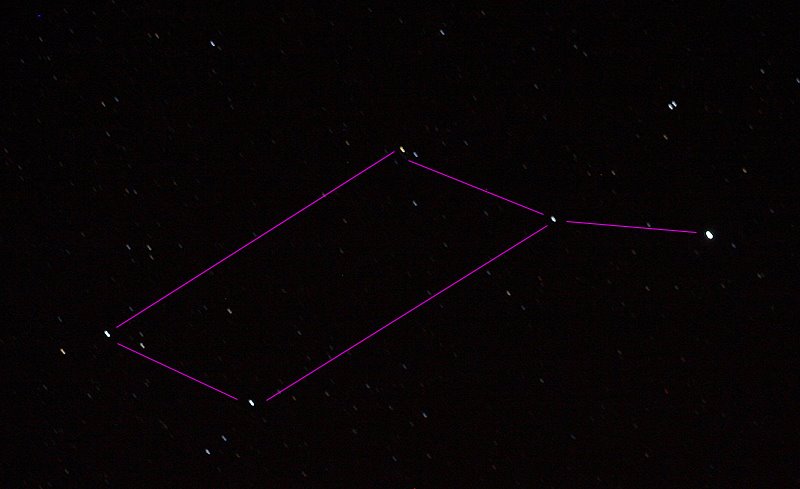
First up was Lyra...


Next was Cygnus....


Then Cassiopeia....


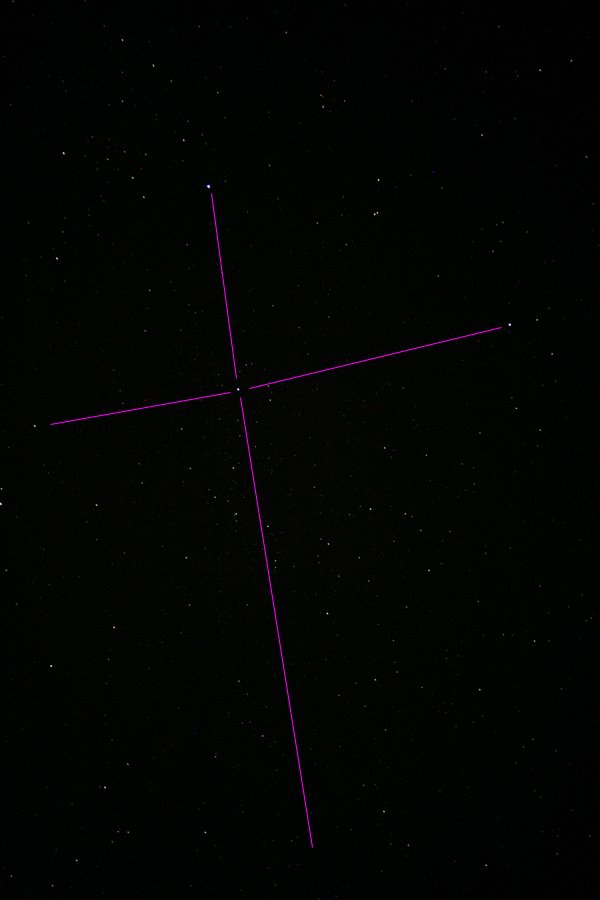
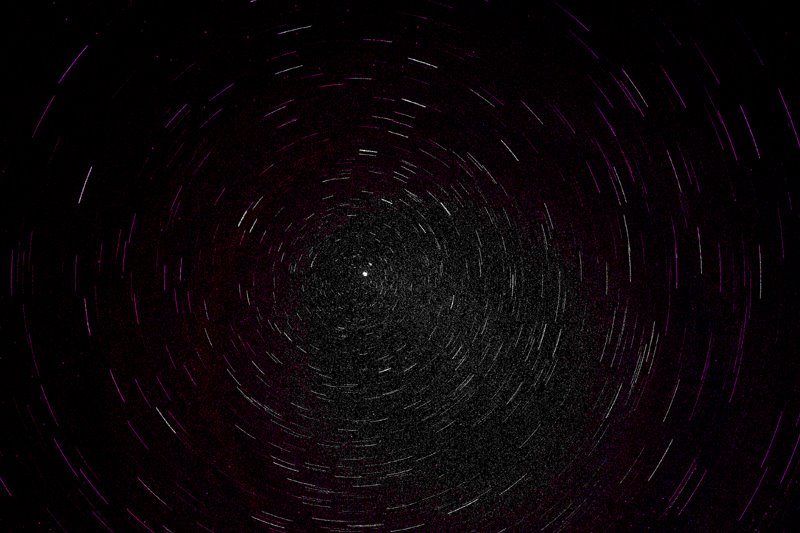
Finally, I've always wanted to try one of those photos where the stars trail around Polaris...


This final picture was a 30 minute exposure, and it took nearly another 30 mins for the camera to process it. After all that there was a lot of noise, the image above was after post processing in Photoshop to reduce noise and adjusting levels.

Wednesday, October 04, 2006

First clear night for weeks and I had to go out to a social event with work! Got home around 10.30 and managed to drag the skywatcher outside, by this time though the moon was beginning to spoil most of my visible sky.

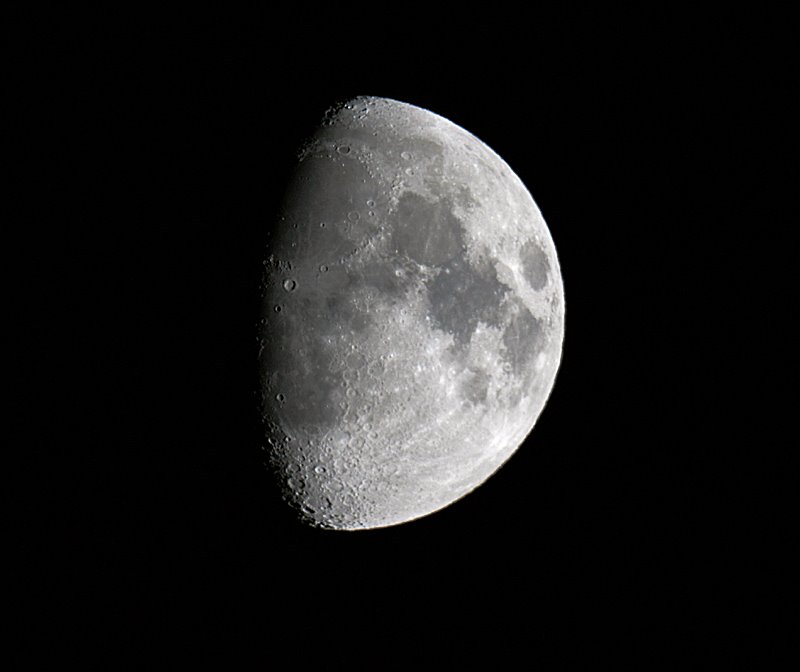
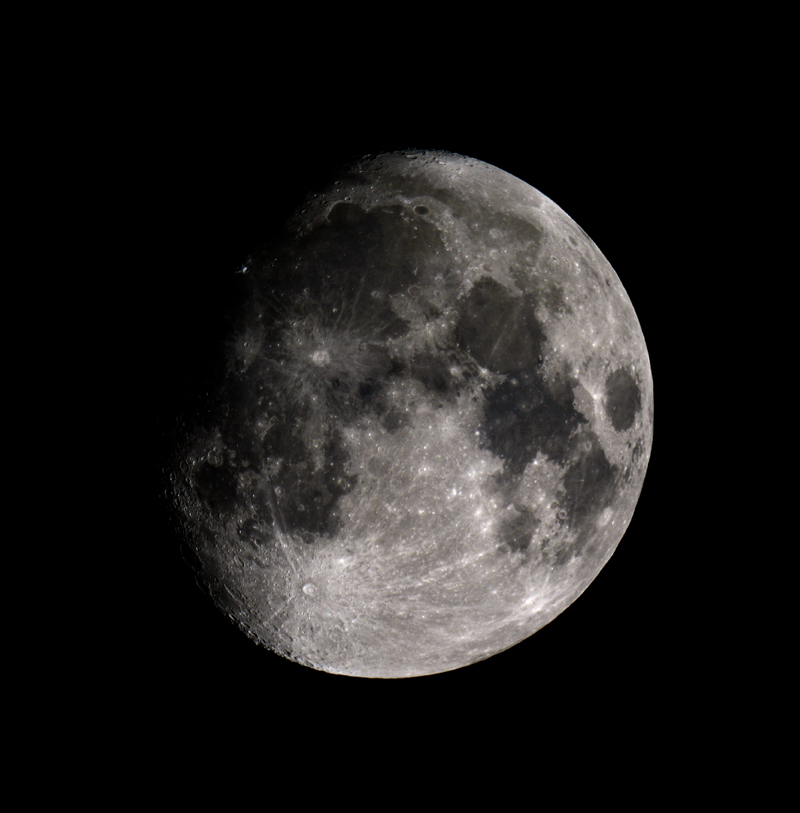
Only one thing for it then, take my first look at the moon through the new scope, awesome is the word, and that's through the lowest power eyepiece. Next task then was to see how much of the frame is filled with the camera?


Canon EOS350D, ISO:100, 1/500s, 35mm equiv focal length 1600mm.

I'm quite pleased with the result! I've cropped some blank sky to the left as the moon had drifted between shots and was thus to the right of the frame, but the vertical proportions are as is. I took a dozen shots and bracketed all the way between 1/60s to 1/500s.

Off to bed now as work in the morning :o(

Mitch